

Allied Health Workforce: Supporting Rural Providers, with Chris Laman
Date: March 17, 2026
Duration: 14 minutes
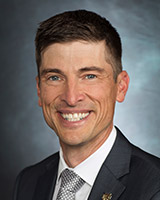 An interview with Chris Laman, Vice President of Strategy
at Columbia Memorial Hospital in Astoria, Oregon. In this
episode, we learn about the importance of developing and
maintaining the rural allied health workforce. Part 2 in
a 3-part series from the December 2025 Health Innovation
Potluck held in Hutchinson, Kansas.
An interview with Chris Laman, Vice President of Strategy
at Columbia Memorial Hospital in Astoria, Oregon. In this
episode, we learn about the importance of developing and
maintaining the rural allied health workforce. Part 2 in
a 3-part series from the December 2025 Health Innovation
Potluck held in Hutchinson, Kansas.
Listen and subscribe on a variety of platforms at PodBean.
Organizations and resources mentioned in this episode:
Transcript
Andrew Nelson: Welcome to Exploring Rural Health, a podcast from the Rural Health Information Hub. My name is Andrew Nelson. In this podcast, we'll be talking with a variety of experts about providing rural healthcare, problems they've encountered, and ways in which those problems can be solved.
In December, I traveled to the Health Innovation Potluck in Hutchinson, KS, hosted by Hutchinson Regional Healthcare System. While there, I was able to record interviews with several rural workforce experts. In this episode, I'll be speaking with Chris Laman, Vice President of Strategy at Columbia Memorial Hospital in Astoria, Oregon. Our conversation focused on the allied health workforce.
First of all, Chris, can you tell me a little bit about the community that you serve?
Chris Laman: Astoria, Oregon is on the northwest tip of Oregon. It's a very beautiful community and it was founded in 1811. Historically, we had a lot of loggers and fishermen in the community. Over the last two decades, I'd say it has become more influenced by tourists, which has been great. It's a wonderful community where we have a lot of very hardworking, independent people. Typical rural America, I would say.
Andrew Nelson: I'd like to delve in a little greater depth into one aspect of rural workforce, and that is the allied health workforce. Can you tell us what that is, and how it fits into staffing at Columbia Memorial?
Chris Laman: So, most people think of doctors and maybe nurse practitioners or physician assistants who are providing the care. But there are a lot of other licensed caregivers not only in the clinics, but in our pharmacies and in our surgery departments. So these are folks like sterile processing technicians or pharmacy technicians, or medical assistants, laboratory technicians, MRI, CT technicians. And so, they're really the core group that keeps the hospital running. You have to have all of these people to be able to provide the services that a hospital provides.
Andrew Nelson: Can you tell me about how CMH identifies which allied health roles are most critical to invest in, both today and a few years down the road?
Chris Laman: As part of our strategic planning process, when we're looking at the growth that we anticipate, whether it be in the hospital, inpatient services or outpatient services, part of the discussion in the planning is not just which providers are we going to need to add, but, now that we've added this provider, what are the other professionals that we're going to need to add in order to be able to really have a high-functioning clinic? And so, [we] have a lot of discussion about imaging expansion and what we're going to need to add there. And as you add a surgeon or a urologist, not only are they doing procedures in the operating room, but they're also doing procedures in their clinics. And so, things like sterile processing become so important because all that equipment that they're using to do those procedures is then coming back to our sterile processing. So those sterile processing technicians, if you don't have them working in your hospital, you're not getting equipment back to the clinic so that they can do those procedures.
Andrew Nelson: Can you tell me about the kinds of partnerships you may have formed with schools in your area to help support allied health education so that you're able to hire people from your community?
Chris Laman: Our community college is probably the most engaged with us in terms of partnerships. And so, with medical assistants specifically, they for years have had a medical assistant program that we have supported as an organization, probably more than 15 years that I have been there. We have given supplies and rotation sites for the medical assistants, but after COVID, their program has started to dwindle and there has been tremendous growth in our organization. So, we've added 50 new providers to the community over the last number of years. And so, the need for medical assistance was very acute. So, we developed a scholarship program where we will pay the full cost of tuition for the medical assistant program at the college for people who commit to two years of service to CMH after they complete that program. But we also have other partnerships, whether it's with pharmacy schools or physical therapy schools, where we're bringing in their students to host rotations at CMH. And that has helped us with recruitment.
Andrew Nelson: I'm sure it's extremely helpful for allied health students in your area, having that scholarship program to take advantage of. Are there any other barriers that potential staff in your area have to overcome that you've helped them address, like transportation or that kind of thing?
Chris Laman: I think the one that I would highlight most is just the cost of education outside of tuition. So what we found after starting the scholarship program is, we still had people in the community who were really interested in going to the medical assistant program, but they were a working mom or a working father who didn't have the time to go up during the day when those medical assistant classes were offered because they had a job. They wanted to get into healthcare and be a medical assistant, but they couldn't leave the job and go to school full time, even if we were going to pay for the whole education. And so, what we did was create an internship program, sort of a train-your-own program at the hospital. It started out with two community members who we brought in, and we did all the training that they would have gotten at school, and we paid them as medical assistants while they were going through that program again for a couple-year commitment to the hospital after they were done. And after that first cohort, we had many more applications for the second cohort, and I think we had 26 or 27 applications for the spots in this last cohort that will start up in January. So, we've really tried to sort of think outside of the box at all of the challenges that people in the community are facing to allow them to have access to better themselves.
Andrew Nelson: That's very empowering for them. And obviously whenever you can train people from your community, your prospects for retention really go up as well. Are there any training models that you've found to be especially helpful when it comes to educating that workforce, whether it's apprenticeships or simulation-based learning?
Chris Laman: I am going to talk about it, but I am definitely not the person who came up with these ideas or developed the programs. I think we have expanded those apprenticeship programs or train-your-own programs. It started in sterile processing where we're training our own there. It moved to the pharmacy where we're doing it with pharmacy technicians, and now we're also doing it with the medical assistants. So there's three different programs that we have where we're taking people from the community and growing them and developing them. So, each of the individual leaders — the director of our surgery program, the manager in our pharmacy, and we've got an MA [medical assistant] leader who has really taken ownership of this and grown and developed — have worked through their professional societies to find resources to develop those programs. But what I can say is we have very standardized programs now, so that they're not just getting on-the-job experience. There is actually classroom experience and specific information that's gone over in each week of the program to make sure that they're not just learning how to be an MA in our urology clinic — they're learning all of the skills that they need to be an MA or a pharmacy technician or sterile processing anywhere.
Andrew Nelson: It seems like you're well on your way to establishing a sustainable allied health pipeline. Are there any little tweaks or adjustments that you are planning to make in the future, or anything that you'd like to be able to change?
Chris Laman: We would love to expand the programs. It has done so much to help us in the pharmacy with our medical assistants. I think seven of our seventeen pharmacy technicians have come from this program. And there are many MAs that have come from either the community college and the scholarship program, or our own internal program. We don't have space in our hospital currently to have more of these MA interns. It's a classroom space thing. And so, we've started talking with the community college about, "Is there a way we can use your space?" We're sort of competing for them with that, because they have a medical assistant program. So that's something that we're working through, but how we grow the programs thoughtfully is something that we're working on.
Andrew Nelson: It definitely sounds like you're not currently dealing with any shortage of opportunities for those folks. Do you have any current employees who are interested in transitioning into allied health roles? And if so, how do you help them through that change?
Chris Laman: Actually, that was one of the exciting things that came from this program. So, registration team members get into healthcare and they're working on the phones and answering and helping with scheduling and all those things. But a pharmacy technician position pays more than a registration position. And so many of the pharmacy technicians that we've had are people who started out in that registration position, but it became well-known throughout the organization that we wanted to promote our team from within to move into that pharmacy technician role. So, it is becoming more and more well-known throughout the organization that that is an opportunity. And then I'm very excited to share that one of our sterile processing technicians has continued to improve herself, and after the program, took classes and is now enrolled in nursing school. And we have a pharmacy technician, not someone who came from the program, but has just left our community, because organic chemistry and some of the other things that she needs to have to take pharmacy weren't available at our community college, but has taken those at a university now and is on a track to get into pharmacy schools. So, we're very much wanting to promote development of our team and when other caregivers see that, it's inspirational to the other people within the organization.
Andrew Nelson: Would you say that it's gotten easier over time for you to find people who want to pursue that career track?
Chris Laman: Especially as the word of mouth, which is just what you said, as the people who are doing that are talking to other folks within the organization or the community, that has been some of our best recruiting tools. And after they've done the role — I'll use the pharmacy as an example — they know the type of personality that it takes. So, they're telling their friends or colleagues who they know have that similar very detail-oriented type personality about how much they love the job, and that is a great source of recruitment.
Andrew Nelson: It sounds like you've been extremely successful with these allied health training initiatives so far. What kind of outcomes or metrics do you use to measure your success?
Chris Laman: On the pharmacy side specifically, we look at the open positions. And I guess that's across all three of those. But then also the amount of contract labor or agency staff that we're having to use. So, after the pandemic, we've been adding all of these providers, all of our sterile processing technicians, were contracted agency. We have to have those positions to keep our OR and the clinics going. So, we track that, and over the last couple of years, we've significantly been able to reduce the amount of contract labor that we're using to fill these positions, which is a great success for us.
Andrew Nelson: It's great that you can just have those folks in-house. Now you don't have to go outside of that space.
Chris Laman: When you are within the organization and employed by the organization, they do a better job, right? I mean, especially in a position like sterile processing where there's all of these very specific things that we're doing for our organization. If you have agency people coming in every few months and changing, they don't know our system, they don't care about our supplies, necessarily. They're not being as thoughtful and diligent. I'm generalizing, but you just don't have the same level of commitment as somebody who's from the community and employed in the organization.
Andrew Nelson: I'm sure the team's a lot better integrated when you have that situation.
Chris Laman: This all came from our manager- or director-level team. It was them coming up with an innovative idea. Maybe it had been done at other organizations, but is there a way that we could do it here? And that surgery director who came to the exec team and presented it, and then that idea snowballing into pharmacy technicians and medical assistants, shows how one person coming up with this great idea can lead to so much other great stuff that goes on within the organization.
Andrew Nelson: You've been listening to Exploring Rural Health, a podcast from RHIhub. In this episode, we spoke with Chris Laman, Vice President of Strategy at Columbia Memorial Hospital during the Health Innovation Potluck in Hutchinson, Kansas. Look in our show notes for more information about their work and visit ruralhealthinfo.org for all things pertaining to rural health.