

Active Aging for L.I.F.E.
- Need: To increase behaviors that will promote healthy aging in rural Oklahoma.
- Intervention: Active Aging for L.I.F.E. offers a college class, lunch and learns, and a high school program that teaches students how their behaviors affect aging.
- Results: High school students demonstrated more positive beliefs about growing older, better awareness of the role of physical and brain health, and an increased appreciation for older adults.
Evidence-level
Effective (About evidence-level criteria)Description
Oklahoma State University's Alliance on Aging in Stillwater, Oklahoma, is a network of faculty and associates studying active aging and age-friendly services. In 2016, Alliance on Aging began a public health initiative called Active Aging for L.I.F.E.
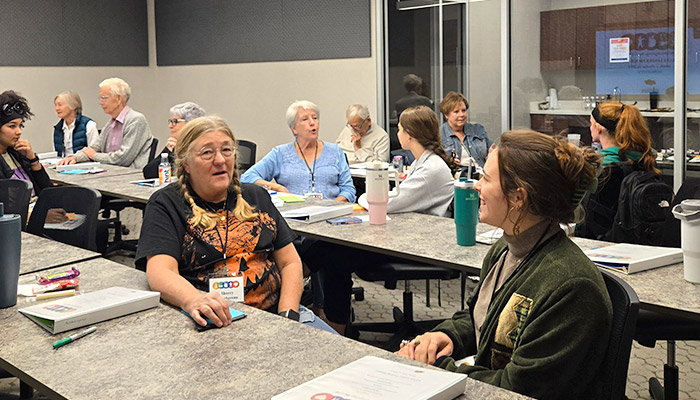
The original program was a four-week speakers' series that brought together adults aged 65 and older and younger adults aged 18-25. Younger adults learned how healthy choices and behaviors impact aging. Older adults shared their experiences with younger generations and learned ways to improve their own well-being.
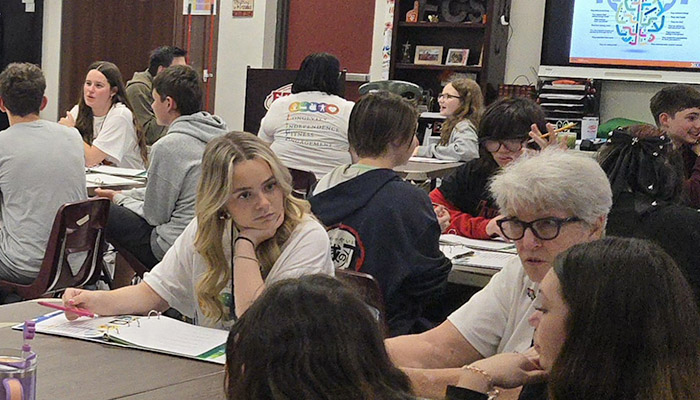
Now, the scalable program is shared in different formats, such as a semester-long class for college students, half-hour seminars and hour-long lunch and learns for the private sector, and the L.I.F.E. Leader High School Program. This program is led by teams of older adults and adults aged 18-25, with six to eight people on each team. The team meets with rural high school students four times to cover the four L.I.F.E. topics: Longevity, Independence, Fitness, and Engagement.
The L.I.F.E. Leader High School Program has a three-year grant from the Next50 Foundation and has reached four out of its six target schools.
Services offered
Active Aging for L.I.F.E. sessions cover the following topics:
- Longevity: nutrition, financial sustainability, aging demographics in Oklahoma, and cultural factors from Blue Zones (global communities with higher populations of adults aged 85 or older)
- Independence: aging independently in one's home and community, senior cohousing, lighting for aging eyesight, and wearable technology
- Fitness: physical fitness strategies, mental health, and the relationship between physical and cognitive health
- Engagement: volunteering, lifelong learning, civic participation, and building community for dementia care
L.I.F.E. Leader High School Program students complete a pre- and post-survey about health understanding and behaviors, and they write a reflection called "See me at 70," in which they write a letter to their future selves or imagine their future selves writing a letter to them.
Results
In the pre- and post-survey, L.I.F.E. Leader High School Program students demonstrated more positive beliefs about growing older, better awareness of the role of physical and brain health, and an increased appreciation for older adults. Many students also reported being more aware of how aging can impact independence and social connections, suggesting greater empathy and preparedness for their own aging and the aging of family members.
In a 2017 study, 20 college students and 23 older adults who attended the original program conducted a pre- and post-survey. The college students reported a significant decrease in their view that "aging is a time of loss" and a significant increase in seeing independence as supported by where one lives and in seeing brain exercise as important as physical exercise. Both age groups reported that the L.I.F.E. topics were relevant to them.
A 2018 study discussed six focus groups with 30 participants held six months after the original Active Aging for L.I.F.E. program ended. The participants described how their attitudes and behaviors related to aging changed after the series. Older adults discussed proactive coping strategies and understanding their own abilities and limitations. Younger adults shared that they had taken steps to avoid social isolation and were thinking about aging in new ways. In addition, younger adults shared what they learned with family members. Both age groups discussed the importance of healthy choices and social connectedness.
For more information about the original program:
Clare, G., Jayadas, J., Roberts, E. & Hebert, P. (2018). Lessons Learned from the Active Aging for L.I.F.E. Intergenerational Programming: College-Age Student and Older Adult 65+ Focus Group Perspectives. Journal of Intergenerational Relationships, 17(2), 220-233. Article Abstract
Clare, G., Jayadas, A., Hermann, J., & Roberts, E. (2017). Spanning the Ages: Intergenerational Mentoring for L.I.F.E. International Journal of Prevention and Treatment, 6(3), 50-57.
Roberts, E., Bishop, A., Ruppert-Stroescu, M., Clare, G., Hermann, J., Singh, C., … & Slevitch, L. (2017). Active Aging for L.I.F.E.: An Intergenerational Public Health Initiative Addressing Perceptions and Behaviors Around Longevity, Independence, Fitness, and Engagement. Topics in Geriatric Rehabilitation, 33(3), 211-222. Article Abstract
Replication
In a 2018 study of the original program, focus groups suggested choosing a venue where people can more easily see and hear whoever is speaking (such as a lecture hall), providing details and specific examples during presentations, and building in time for the two generations of Active Aging for L.I.F.E. participants to talk with one another about specific topics.
Focus groups from the original program also recommended keeping presentations around 45 minutes or one hour long and building in time within the presentation for questions, group discussion, or hands-on activities. In addition, they recommended providing pens and paper for taking notes and sending participants home with printed materials or directing them to more information on websites.
Contact Information
Dr. Emily Roberts, Associate ProfessorAlliance on Aging
828.275.5212
emily.roberts12@okstate.edu
Topics
Aging and aging-related services
· Health literacy
· Older adults
· Schools
· Social connectedness
· Wellness, health promotion, and disease prevention
States served
Oklahoma
Date added
February 20, 2026
Suggested citation: Rural Health Information Hub, 2026. Active Aging for L.I.F.E. [online]. Rural Health Information Hub. Available at: https://www.ruralhealthinfo.org/project-examples/1157 [Accessed 21 October 2026]
Please contact the models and innovations contact directly for the most complete and current information about this program. Summaries of models and innovations are provided by RHIhub for your convenience. The programs described are not endorsed by RHIhub or by the Federal Office of Rural Health Policy. Each rural community should consider whether a particular project or approach is a good match for their community’s needs and capacity. While it is sometimes possible to adapt program components to match your resources, keep in mind that changes to the program design may impact results.