

HealthScreen at UF HealthStreet
- Need: To provide chronic disease screening and follow-up services to people in rural North Central Florida.
- Intervention: A mobile health program that hosts screenings at community events.
- Results: The program has seen at least 225 people per quarter.
Description
The University of Florida's HealthStreet program relies on community health workers (CHWs) to connect people in Florida's North Central region to relevant medical and social services and opportunities to participate in research. HealthStreet CHWs meet people where they are in local communities to provide health assessments.
In 2025, HealthStreet leaders expanded the program and launched HealthScreen, an initiative that offers no-cost screenings for chronic diseases (hypertension, heart disease, diabetes, and stroke). Screenings take place at HealthStreet and in the community via mobile health vehicles and are conducted by nurses from the university's Clinical and Translational Science Institute.
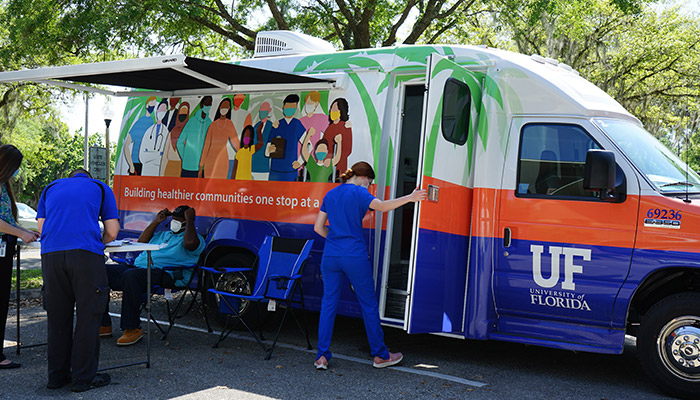
HealthScreen currently serves community members in eight counties in North Central Florida, covering an approximately 60-mile radius with funding from the Florida Department of Health's Dr. and Mrs. Alfonse and Kathleen Cinotti Health Care Screening and Services Grant Program.
Services offered
Screenings take place at community events throughout the week. Once a person agrees to be screened and signs a consent form, CHWs collect medical information and information on social determinants of health. They perform an introductory blood pressure screening and a BMI test before the person sees a nurse. A nurse will conduct the remaining screenings and provide results directly to the participant before they leave. The CHW then provides appropriate referrals based on the screening results. In cases where the person's results are particularly concerning, the CHW will urge them to seek treatment immediately, or will even call EMS for them.
Sixty days after the screening, a CHW will make a follow-up call to see if the person has sought care. At this time, they can provide additional or alternative referrals if needed.
Results
HealthScreen has screened at least 225 people per quarter year, and has referred most of them to care. In the first quarter (April through June 2025), 211 of the 234 total people screened needed treatment.
Challenges
Funding is an ongoing challenge. Finding and retaining nurses, drivers, and CHWs who were effective at interacting and communicating with community members was also a challenge at the start of the program.
Replication
The existence of the HealthStreet program made it easier for the HealthScreen program to get off the ground, program leaders say, because they didn't have to start from scratch.
They recommend thinking outside the box when it comes to community partners – being open to partnering with meatpacking plants or foreign consulates, for example. They also recommend going out into the community and talking with people who are not affiliated with agencies or the healthcare system to get a broader perspective on community needs.
Contact Information
Linda B. Cottler, PhD, MPH, FACE, FACTS, Professor, Department of Epidemiology and Founding Director, HealthStreetUniversity of Florida
HealthScreen
lbcottler@ufl.edu
Topics
Access
· Community health workers
· Health screening
· Nurses
States served
Florida
Date added
May 18, 2026
Suggested citation: Rural Health Information Hub, 2026. HealthScreen at UF HealthStreet [online]. Rural Health Information Hub. Available at: https://www.ruralhealthinfo.org/project-examples/1163 [Accessed 10 October 2026]
Please contact the models and innovations contact directly for the most complete and current information about this program. Summaries of models and innovations are provided by RHIhub for your convenience. The programs described are not endorsed by RHIhub or by the Federal Office of Rural Health Policy. Each rural community should consider whether a particular project or approach is a good match for their community’s needs and capacity. While it is sometimes possible to adapt program components to match your resources, keep in mind that changes to the program design may impact results.