

Ohio Northern University's HealthWise Mobile Outreach Program
- Need: The results of a 2013 county need assessment revealed that increased healthcare access would benefit the low resource areas of rural Hardin County, Ohio.
- Intervention: With grant awards that included a 2015-2018 federal grant and in collaboration with local healthcare delivery systems, a rurally-located university pharmacy program's faculty and doctoral learners brought regularly scheduled pharmacist-led mobile clinic health services — ONU HealthWise Mobile Clinic — to the low resource areas of Hardin County, Ohio.
- Results: In the decade since the original grant award, pharmacist-led mobile healthcare services' continued success has led to an expanded operation with a dual focus of providing both rural healthcare services and a setting to train rural practice-ready pharmacists. Additionally, interprofessional experiences for other healthcare profession learners have been added. In 2025, state-granted financial support allowed growth to include the purchase of a second vehicle expanding community pharmacy and telehealth services in surrounding rural counties.
Description
 Located
in Ada, Ohio Northern University (ONU) is a private
college affiliated with the United Methodist Church. One
of the university's missions is to focus on the health
and well-being in rural and low resource communities.
Through the ONU HealthWise program, faculty, staff, and
student pharmacists provide care through a fully
operational employee health program, community pharmacy,
a drug information program, pharmacy call center, and a
mobile health program.
Located
in Ada, Ohio Northern University (ONU) is a private
college affiliated with the United Methodist Church. One
of the university's missions is to focus on the health
and well-being in rural and low resource communities.
Through the ONU HealthWise program, faculty, staff, and
student pharmacists provide care through a fully
operational employee health program, community pharmacy,
a drug information program, pharmacy call center, and a
mobile health program.
With initial planning in 2013 for a mission-driven outreach program, ONU's Raabe College of Pharmacy leaders — already delivering the university's pharmacist-led employee wellness program — completed a review of the Hardin County community needs assessment. The report highlighted both transportation and the limited numbers of healthcare providers as having the most influence on the county's health and wellness. Pharmacy faculty recognized that some service gaps were within a pharmacist's scope of practice and could be addressed by pharmacist-led mobile services.
Original planning also involved engagement with Hardin County residents to further understand their health needs, followed by collaboration between the university's pharmacy leaders, and several Hardin County clinical partners with missions aligning with ONU's. This work led to the development of the ONU HealthWise Mobile Clinic. Along with other funding that purchased a retrofitted 37-foot recreational vehicle, a 2015-2018 Federal Office of Rural Health Policy (FORHP) Rural Health Care Services Outreach Grant contributed to supporting personnel and supplies to provide a clinic-like mobile environment.
The outreach effort also resulted in dual-purposed work: first, providing healthcare services and second, providing their pharmacy doctoral candidates a clinical experience setting that allowed them to develop practice readiness for future work in a rural setting.
During the start-up years, ONU HealthWise Mobile Clinic met with success, building community trust with the care provided by the pharmacy faculty/learner team model. With its established mobile infrastructure, during the COVID pandemic the HealthWise team was tasked by the state governor's office to provide care to a geographic area that included both urban and rural communities in 14 counties.
By 2024, the dual focus of the HealthWise Mobile Clinic was well-positioned to meet another unique community need: filling the pharmacy service gaps left as a result of a national pharmacy chain's closure of several local pharmacies — pharmacies that had been filling and dispensing medications along with providing some mail order and delivery services. As the only pharmacy within a 20-mile radius for several surrounding counties' residents, pharmacy faculty and learners expanded the work and services of the ONU HealthWise Pharmacy, meeting community needs and offering continuity of local services.
Not to be overlooked are the interprofessional experiences (IPE) that the ONU HealthWise Mobile Clinic offers to ONU's non-pharmacist healthcare profession learners — and to learners from nearby physician residency programs. The pharmacist-led health services model allows first-hand observation of pharmacists at work within the full scope of their skills as guided by Ohio law. The mobile services also provide the curriculum setting for a rural-focused one-year pharmacy residency offered through the Raabe College of Pharmacy.
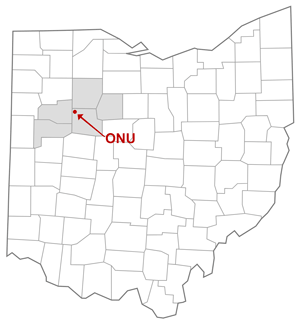 In 2025, the HealthWise program received a $500,000 Ohio
state budget allocation that was used to purchase a
second mobile unit to further increase post-pandemic
outreach to surrounding rural counties, eventually to
include five: Allen, Hancock, Hardin, Wyandot, and
Auglaize.
In 2025, the HealthWise program received a $500,000 Ohio
state budget allocation that was used to purchase a
second mobile unit to further increase post-pandemic
outreach to surrounding rural counties, eventually to
include five: Allen, Hancock, Hardin, Wyandot, and
Auglaize.
Financial sustainability for ONU HealthWise Mobile Clinics is not limited to state funding. Other support comes from Ohio's Charitable Health Network membership, integrated community and pharmacy telehealth services, and because Ohio pharmacists have "provider status," some billable pharmacist services. ONU pharmacist faculty core to these efforts also routinely complete grant applications. Mentioned earlier, early support came from the 2015-2018 FORHP Rural Health Care Services Outreach Grant.
Services offered
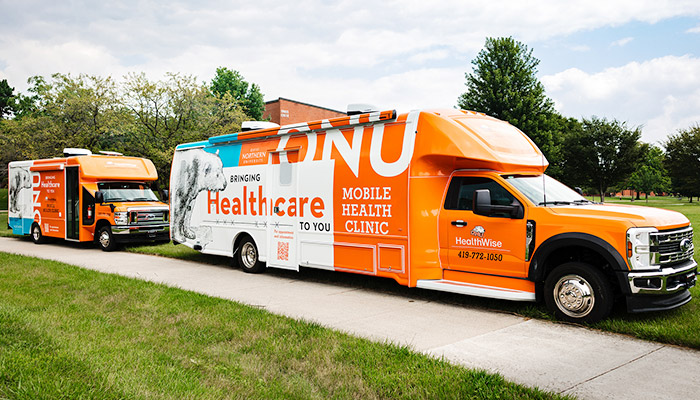
Service delivery in the mobile clinics mirrors the healthcare services' delivery operations of the campus community pharmacy. The largest vehicle is 37 feet with two exam rooms, a multipurpose room used for reception, laboratory services, and areas to provide comprehensive clinical services to include diagnostic testing, screening, and point-of-care testing. A second 25-foot van makes visits to smaller sites and can be used for focused outreach events. It, too, offers one exam room and a multipurpose room that functions as a reception and lab/patient care area. Both units are supported by onboard generators and have the medical-grade equipment and furnishings needed to support interdisciplinary care.
Staffing:
- ONU student pharmacists and their supervising faculty
- Ancillary medical personnel to meet the patient flow of a mobile clinic setting
- Non-pharmacist ONU health profession learners and physician residents from training programs
Appointment scheduling and locations:
- Visits are scheduled by phone or by email; walk-in appointments are also often accepted
- Community site visits are usually 4 days per week
- Clinic location examples: parking lots, food pantries, churches, community centers, businesses, senior apartments, senior centers, and schools
Many service details are listed in a 2022 comprehensive report, some to include:
- Clinic visit's 4 patient touch points:
- Intake: Demographic information, contact information, insurance information
- Medical history, medication history, and review
- Assessment and intervention:Preventive health education, medication reconciliation, comprehensive medication management and titration, physical assessment and screenings, and immunizations
- Check out and follow‐up plan: Coordination of care, provider referral, monitoring plan, follow-up scheduling
Specific services include:
- Health education offerings:
- Individualized patient education with 1:1 face-to-face education and coaching
- Health risk/chronic disease preventive care discussions
- Medication use and adherence
- Printed health information
- Medication reconciliation, management, and titration for chronic conditions
- Tobacco cessation services
- Health screenings including: body mass index, cholesterol, blood glucose, blood pressure assessments, bone density, spirometry, cancer-focused skin examinations, hepatitis C detection
- History-guided cancer screening advice with a tailored approach for recommending breast, cervical, and colorectal cancers
- Immunizations for children and adults
- Referral to outside care, specialist, and/or emergency/urgent care as needed
 Educational pedagogy:
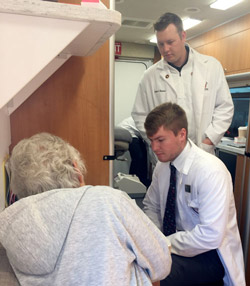
- Layered Learning Staffing Model: A teaching strategy designed to train the more senior pharmacy resident to precept the student pharmacists and other health profession residents with the oversight of a supervising faculty pharmacist
- Team-based comprehensive primary care: Resident pharmacist and resident physicians paired for care delivery, each learning from the other and allowing physician trainees direct access to pharmacy specialists as the one health profession specialty that has the most comprehensive training related to medications
For more on this program:
Rural Health Information Hub, 2026.The Rural Monitor. Unapologetically Built Backwards: ONU HealthWise, Pharmacist-Driven Healthcare Access in Rural Ohio.
Results
Sustainable Impact
- Creation of a sustainable high impact rural training site
- Provision of professional services equal to meeting many community needs
- Establishment of community trust
Specific 2024-2025 Impact:
- More than 160 clinics held in seven counties
- Nearly 750 clinical encounters with over 300 unique patients
- Over 1,400 diagnostics tests and screenings with around 50% of blood glucose and cholesterol tests found to be abnormal and, of blood pressure measurements, nearly 60% were abnormal
- More than 1,800 student pharmacist hours completed
For more on this program, see:
Rural Health Information Hub. Unapologetically Built Backwards: ONU HealthWise, Pharmacist-Driven Healthcare Access in Rural Ohio.The Rural Monitor. 2026.Challenges
Previous Challenges:
- Initial technology challenges to create a user-friendly electronic health system functional for remote care documentation requirements
- Community education to introduce:
- Pharmacist-driven mobile clinic services as a valuable community healthcare access point
- Pharmacist scope of practice
Current Challenges
- Need for participation in expansion efforts regarding pharmacist scope of practice and provider status in order to be able to offer the full spectrum of pharmacists' professional services needed in rural communities
- Routine re-evaluation of workflow practices to promote smooth service delivery
- With community need exceeding current resources, routine re-evaluation of service sites in order to ensure operation in areas best served
- Interprofessional coordination of care challenges due to interoperability electronic health record limitations
- Identification of billing opportunities for model's sustainability
Replication
Existing now for a decade, the program's initial lessons learned can still serve as a starting list for any other organization wanting to replicate efforts.
- Essential at program startup is the pre-planning needs assessment review and connecting with community leaders and potential clinical partners.
- Additionally, a community's feedback should be sought not just during the planning stages, but routinely after project launch since needs may not be intuitive to the service providers.
- Patience/respect for time intervals required to establish collaborative relationships.
Because the ONU HealthWise Mobile Clinics services change rapidly due to healthcare policy changes and the evolving healthcare needs of rural communities — and sometimes urban populations —anyone interested in the current model should contact ONU pharmacy leaders.
Contact Information
Stuart Beatty, PharmD, MPAL, BCACP, FAPhA, Dean, Ohio Northern University Raabe College of PharmacyOhio Northern University
419.772.2277
s-beatty@onu.edu
Topics
Access
· Health screening
· Health workforce education and training
· Mobile and episodic healthcare delivery
· Pharmacy and prescription drugs
· Pharmacy workforce
States served
Ohio
Date updated or reviewed
March 20, 2026
Suggested citation: Rural Health Information Hub, 2026. Ohio Northern University's HealthWise Mobile Outreach Program [online]. Rural Health Information Hub. Available at: https://www.ruralhealthinfo.org/project-examples/999 [Accessed 25 October 2026]
Please contact the models and innovations contact directly for the most complete and current information about this program. Summaries of models and innovations are provided by RHIhub for your convenience. The programs described are not endorsed by RHIhub or by the Federal Office of Rural Health Policy. Each rural community should consider whether a particular project or approach is a good match for their community’s needs and capacity. While it is sometimes possible to adapt program components to match your resources, keep in mind that changes to the program design may impact results.