

Feb 18, 2026
'No Safe Level of Lead': How Mining Towns Are Reducing the Risk of Lead Exposure – And What Other Rural Communities Can Learn from Them

Today, the picturesque landscape of the Bunker Hill Superfund Site shows few signs of the region's contaminated history.
What was once an "ugly, treeless, barren" area with a river clouded gray — a result, in large part, of decades of mining and smelting lead and other metals in Idaho's Silver Valley — has transformed over 40-plus years of cleanup and revegetation efforts, says Mary Rehnborg, Institutional Controls Program Manager for the Panhandle Health District. Today, the valley is made up of "lush and green" hillsides, clear water running between them.
But the restored landscape of the Superfund site, spanning 1,500 square miles in northern Idaho and eastern Washington, doesn't tell the whole story of the mining industry's impact — and doesn't reflect the serious health risks that still exist for people living nearby.
"Historically, when you would come to our area, those visual cues [in the landscape] made it very apparent that there was something going on here that was not normal," Rehnborg said. "Those visual cues are disappearing. People don't realize that there is still legacy mine waste here and that there are still exposure issues and hazards."
The rural Silver Valley has been home to some of the highest lead exposure levels recorded in the world. A 1973 fire in a lead smelter's baghouse — which housed its primary filtration system — led to acute lead poisoning diagnoses for dozens of children in surrounding communities, one of which registered the highest-ever recorded blood lead level in an individual.
Since then, blood lead levels in the Silver Valley have seen a "drastic decline," a drop Rehnborg attributes to cleanup efforts since the Superfund site's 1983 placement on the Environmental Protection Agency's National Priority List and ongoing community education around the lead exposure risks that still exist and how to mitigate them.
While exposure risk may be especially high in Kellogg and other mining towns, lead poisoning can pose an invisible danger to rural communities and residents everywhere. As communities look to address these risks, efforts to grow public awareness, encourage testing, and expand resources in the Silver Valley and elsewhere may offer a blueprint.
Taking a backseat
The health impacts of lead exposure are well-documented: potential effects of childhood exposure include damage to the brain and nervous system, slowed growth and development, learning and behavioral issues, and hearing and speech problems, according to the U.S. Centers for Disease Control and Prevention (CDC). Children younger than six years old tend to face the highest risk.
In rural communities, factors such as older housing stock with lead-based paint, limited community resources, and a stigma or distrust around reporting lead hazards can all contribute to a higher exposure risk, according to Kara Knapp, a research associate in the Department of Family Medicine and Community Health at the University of Kansas Medical Center who studies lead exposure in rural communities. Historic farming practices involving the use of certain pesticides, such as lead arsenate, have also contributed to ongoing soil contamination hazards in some rural areas.
Among rural families, especially those facing other, more seemingly urgent challenges related to finances, housing, or food insecurity, lead exposure is often not seen as a priority, said Jody Love, chief executive officer of the Healthy Bourbon County Action Team (HBCAT), a nonprofit in rural southeastern Kansas that has been working to address lead exposure in the region in partnership with the University of Kansas.
I don't think that people are really aware that there is no safe level of lead.
"I don't think that people are really aware that there is no safe level of lead," Love said. "I think that there's a common, unwritten understanding that just a little bit of lead isn't going to hurt you. And people are so much more worried about their next meal, paying their rent, and getting their medication that lead exposure kind of takes a backseat."
For families that are aware of the dangers, resources are often not easily — or obviously — accessible, Love added: How, for instance, is a family supposed to know if their pipes are made of lead? If they are made of lead, who is responsible for fixing the problem? And if a blood test finds that your child has lead poisoning, what can you do about it?
"The path to finding either lead testing or follow-up resources is oftentimes not very clear for rural families," Knapp said. "To start, where do they go? Who do they reach out to? And if they do find lead, the follow-up is not always there."
Clearing the path
To encourage testing, the Panhandle Health District's Lead Health Intervention Program provides free blood lead testing year-round for anyone who lives, works, or enjoys the outdoors within the Bunker Hill Superfund Site, and offers a $50 incentive to families to test children between six months and six years old during its annual testing event every August. The event is advertised to Superfund site residents through mailed flyers that include a QR code to make an appointment.
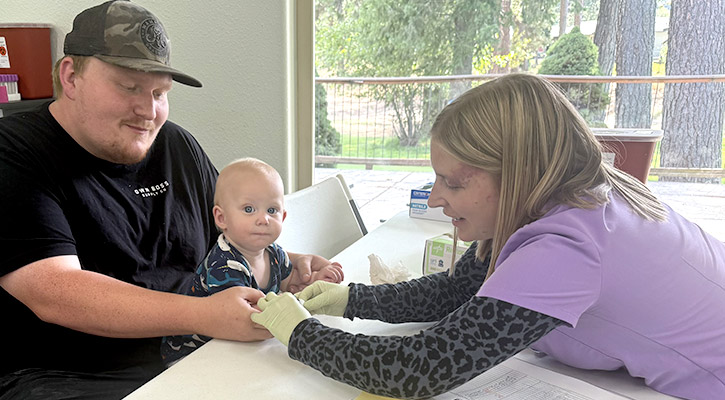
The $50 incentive for young children "draws in a lot of people," Rehnborg said. "We tried doing it for several years without offering the incentive and just providing the testing as a free service, and we had hardly any participation."
This year's event — themed "Under the Sea" and decorated accordingly — prompted a total of 362 tests: 232 kids in the six-month to six-year age range, and 130 people outside of that range. Goody bags with toys, stickers, and candy prizes were handed out to participating kids, and games and coloring books kept children entertained while they wait to be tested by phlebotomists subcontracted from the local hospital.
"When the kids walk into the event, it's not just this sterile cold, environment," Rehnborg said. "It's welcoming and fun and interactive for them."
If a child or adult's test results show elevated blood lead levels, Rehnborg and the public health district's outreach coordinator follow up with at least one optional home visit to investigate the source of the problem. Typically, a "handful" of kids each year — between five and 10 — test at levels that call for a follow-up, Rehnborg said. These visits usually include a questionnaire, conversations with the child's parents, and an inspection of the home to sample for lead-based paint or other possible factors. If needed, health district staff may also test other places the child spends time, such as a daycare or grandparent's house.
A lot of people don't think of it as being a big issue until their child is going through it.
"A lot of our real in-depth education comes from the home follow-ups," Rehnborg said. "There's a lot of hands-on learning with [the families], and it gives them a good perspective. A lot of people don't think of it as being a big issue until their child is going through it."
Through the follow-up program, Rehnborg has been able to track some families over the years, watching their children's blood levels drop to healthy levels.
"It's really rewarding to know that the families were able to identify what the cause was, remove that, and make the change in that child's life," she said.
A public presence
While testing and follow-ups tend to ramp up in August with the annual testing event, educating the public on the dangers of lead exposure and the resources available is a year-round job for the Panhandle Health District.
"A huge part of our program is trying to educate people and ensure that they know the risks or the hazards before they come here," Rehnborg said.
That has meant working with the local real estate community to establish a disclosure rule — in which anybody selling property, renting, or leasing is required to disclose the potential for lead contamination — and setting up a system that lets real estate agents submit an online request to receive all available contamination information and sample data for a specific property from the public health district.
The health district also participates in community events throughout the year, hosting booths at farmers' markets, Fourth of July celebrations, the local Huckleberry Festival, concerts in the park, and the local hospital's annual children's health fair.
Lead awareness education starts early in the Silver Valley, as Rehnborg and her colleagues visit local schools to hold classes for kindergarten through third-grade students. Classes for kindergarteners focus on good hygiene practices, such as hand washing, and incorporate more information about dirt and contamination potential for older students. The health district has also begun to work with high school science and history classes.
"Trying to have a real public presence is an important part of our outreach," Rehnborg said. "We can answer questions and talk with people and engage with them and ensure that they're getting that information."
Community-centered tools
In Kansas, where Knapp and Love's work is centered, research suggests that rural families tend to be at higher risk for lead exposure than urban families. Rates are especially high in the rural southeastern part of the state, a former lead and zinc mining region.
Older housing stock, which often comes with lead-based paint and pipes, is common in this corner of Kansas, Love and Knapp noted, contributing to risks. And Idaho's Panhandle Health District — which funds its lead testing and education efforts through settlement dollars from mining companies — is something of an exception: rural health departments in southeast Kansas and elsewhere are often strained in their capacity to offer robust lead-related resources, Knapp and Love said.
With limited resources available, the HBCAT and Knapp's team at the university have utilized the region's most valuable resource — its residents — to identify challenges and look for fixes. Through a series of community forums and conversations, they recently developed a toolkit to help Kansans identify, prevent, and address lead exposure risks. The toolkit was developed with input and feedback from partners including local health departments, elected officials and governments, business owners, nonprofits, schools, community health workers, and people with lived experience with lead exposure.
"It's a very practical, community-centered toolkit to help people find the resources, build up awareness, and identify shared priorities among us," Knapp said. "We're excited to see how communities use it."
The toolkit is written in basic, accessible language, and includes information about lead poisoning effects, common sources of lead, a checklist for testing and follow-up actions, steps to fix or remove lead exposure sources, and examples of policy approaches that have been effective in other states. Its intended audience is broad, ranging from members of the general public to community and statewide leaders.
Love hopes the toolkit "will really help with some of those low cost-mitigation strategies and will help raise awareness that there's no safe level," she said. "It's a tool that our community members will be able to use to help educate people on why it's important."
The toolkit is tailored to a Kansas audience, incorporating feedback, priorities, and specific challenges identified by local residents. But Love believes that other rural communities can develop similar resources through a similar community-centered process.
"This model is definitely replicable," she said. "It's really a matter of letting the community determine their own priorities and come up with their own solutions. We can't depend on outside entities to come in and tell us how to fix our problems — it really has to come from within."

Gretel Kauffman has been a web writer for the Rural Health Information Hub since 2022. She writes on a variety of rural-specific issues in the Rural Monitor and Models and Innovations. Gretel has a bachelor of arts degree in American Studies from the University of Notre Dame. Full Biography
View all articles by Gretel Kauffman