

Jan 28, 2026
Chain Reaction: Homegrown Programs Encourage Safe Biking in Rural Areas
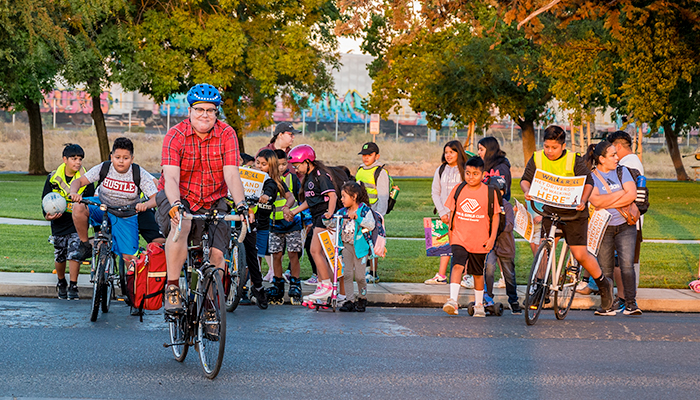
On rodeo mornings, Tom Hothem and his team are up and at 'em at the crack of dawn. They lay out orange cones and traffic signs in careful formation, turn on their radios, and instructors and translators prepare for the day ahead. Then the families show up, and the fun begins.
Hothem and his fellow members of the Merced Bicycle Coalition, a nonprofit in California's San Joaquin Valley, have been hosting "bike rodeos" — events to teach local children and their parents how to get around safely on two wheels — for the past 15 years in the small, unincorporated communities of Merced County. The goal is to encourage more people to give biking a try — and to help them do it as safely as possible.
"If you ride a bike in many of our towns in Merced County, you're often doing it out of sheer necessity," Hothem said. "Nobody bikes in Merced. But the interest and support and enthusiasm is there."
The health benefits associated with cycling are numerous: research suggests people who ride bikes are less likely to develop cardiovascular disease or type 2 diabetes, and face lower risk of mortality generally. In rural communities that lack public transit, and that are too spread out to conveniently walk, biking can also fill gaps in transportation for those who can't or don't drive, cycling advocates note.
But in many rural areas, potential cyclists can be discouraged by a lack of bike-friendly infrastructure or the absence of a local cycling community, said Susan Gaeddert, a cycling advocate who works with communities across Wisconsin — making safety and injury prevention education all the more needed.
We know that active transportation is good for your health. But the infrastructure [in rural areas] is not conducive to safe biking a lot of the time.
"We know that active transportation is good for your health," Gaeddert said. "But the infrastructure [in rural areas] is not conducive to safe biking a lot of the time. And culturally, I think for some people, they wouldn't even think of it."
'Checking Out' Cycling
For residents of Athens County, Ohio, the nudge to consider cycling might come from an unexpected place: their local library.
"Libraries are fundamentally about connecting people to information. And particularly these days, the form that information takes varies widely," said Nick Tepe, Director of the Athens County Public Libraries system. "It's no longer just a bunch of stuff in a book.
"One of the things that we try to do here is help people learn about different ways of solving whatever problems they're facing," he continued. "When you talk about health issues, one way to solve that problem is to get out for regular exercise."
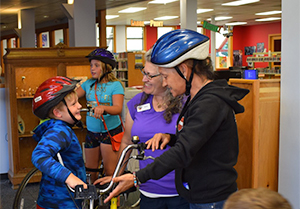
Since 2013, Athens County Public Libraries have offered the Book-A-Bike program, one of the first of its kind in the country. The program, which was initially funded by a state grant and created in partnership with the local health department, lets anyone with a library card check out a bike for three hours at a time at no cost. The library's fleet of bikes — which includes three- and seven-speed bikes, e-bikes, mountain bikes, bike trailers for small children, and a tandem bike — is spread across the library system's seven branches, including branches in the small towns of Nelsonville, Chauncey, Coolville, Glouster, and Albany.
"The primary motivation to start was just to get people out on bikes," Tepe said. "Maybe you don't want to spend a lot of money to get a bike right away. So come to the library. You can check out the bike, give it a try and see how it goes."
Over the past dozen years, the program has attracted a range of patrons: out-of-town visitors, people learning to ride for the first time, "regulars" who don't want a bike of their own but who use the library fleet frequently to exercise. In some cases, the program has also filled transportation needs: One patron checked out an e-bike so he could get to a job interview without working up a sweat; others regularly use the bikes to run errands.
"It's amazing that we have this available to provide the level of freedom that bikes provide to the people in our community who really need it," Tepe said.
Beyond the initial start-up cost of buying the bikes, the program is "pretty much self-sustaining," Tepe said, with a few thousand dollars a year going toward maintaining the fleet. The original fleet of 17 bikes purchased in 2013 is still in service, kept in shape by a local bike shop that comes to the libraries to perform needed repairs once a week during peak cycling months and is on-call during the off-season.
"It's worth it just for people to have access to the program and to know that it exists," Tepe said. "And the way that we see it being used today is exactly what the program was originally created for."
Bike Benefits
Through her work in rural Wisconsin, Gaeddert's seen the benefits of cycling extend beyond individuals' physical health and into the well-being of communities more broadly. Statewide, bicycling added $451 million in value to the state's economy in 2021, according to a report from the Wisconsin Office of Outdoor Recreation [report no longer available online].
"People will go on a bike trip and they're going to spend their money in other places to eat and sleep," Gaeddert said. "We have a lot of rail trails here, and those tend to go through small towns and rural places."
As it has in Athens County, cycling can also fill transportation gaps in places where public transit is sparse or nonexistent. Nationally, eight percent of adults living in rural areas say they seldom or never drive, according to a recent Pew Research Center survey. For those people — and for teenagers and children too young to have a license — bikes can offer both exercise and freedom.
"For many people — although, of course, not all of them — bicycling is a good way to get around if you don't have a car or you can't drive," Gaeddert said. "We have a lot of rural communities without transit at all, and some that have transit systems but they are maybe not very frequent or don't cover an entire area. Bicycling is a good way to complement those systems."
It's also just a good way to get out and meet your neighbors, Gaeddert believes.
"Just getting outside and moving generally is better for you than not," Gaeddert said. "For social reasons, too — just having more opportunity to connect with people and be out in your community."
But in many rural places, in Wisconsin and elsewhere, getting out on a bike comes with challenges. The biggest factor, Gaeddert says, is safety. While recreational biking may be popular in some rural areas — driving your bike to a trail, going on a ride, then driving home — rural roads often aren't designed with cycling in mind. For instance, she noted, rural towns whose Main Streets double as state highways are made for "large, fast vehicles" more so than for bikes.
"That is not very compatible with biking unless you can really be intentional about it," Gaeddert said.
Intentional Injury Prevention
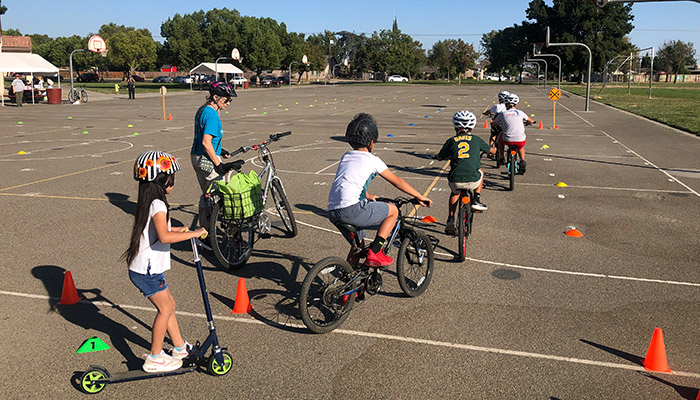
Being intentional about injury prevention is central to the Merced Bicycle Coalition's work. The "rodeos" instruct families how to navigate their small towns' largely sidewalk-less and bike lane-less streets as safely as possible, teaching turn signals, traffic laws, where to ride, and how to stop correctly. Participants bike through a safety course, which includes stop signs and railroad signs, before they graduate to practicing on the road with an instructor.
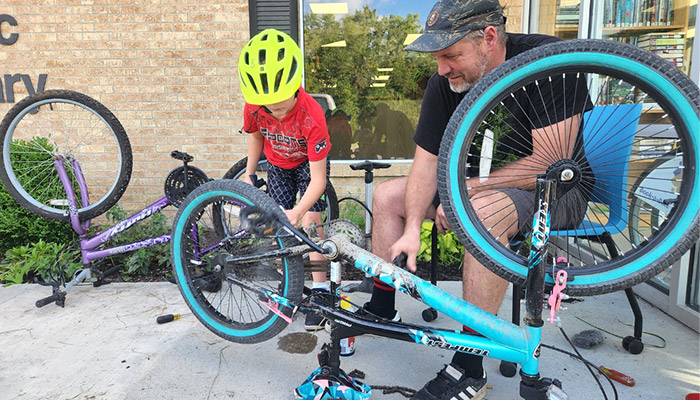
Mills Ewing, the owner of a local bike shop and member of the Coalition, is on hand to fix people's bikes as needed, free of cost, and everyone who attends the event receives a helmet, bell, and light for their bike. Every student in third through fifth grade at the host school also gets a free helmet, whether they attended the event or not.
The events are typically hosted by and put on in partnership with local schools, and are funded through a grant from the national Safe Routes to School program. But they aren't only for kids.
"We try to be clear that this is not a drop-your-kids-off-for-a-fun-Saturday-morning thing. These are family events," Hothem said. "We really encourage parents and families to ride with their kids, to have a shared sense of it. And we've been really pleased to find that very few people do drop their kids off and leave."
Hothem also emphasizes that instruction at the bike safety events isn't "top-down." The dialogue is more a back-and-forth conversation than a lecture, with Hothem and the other volunteers taking time to listen to residents' concerns and questions about cycling.
"I don't want to come in and say, 'Here we are, we're going to do bike safety now,'" he said. "I do a little bit of commiserating with them and sit and listen to the challenges they have with bicycling — things like lacking parts and people to work on bikes, or lacking bike lanes. It's something we undertake with the community."
For his part, Hothem practices what he preaches: he gets around primarily by bike, riding 12 miles back and forth to work each day and using his car an estimated once or twice a week. He acknowledges, with a laugh, that this makes him a bit "weird" in Merced County — but hopes that the more people that are seen out and about on bikes, the more normalized it will become.
"I see it as a lost opportunity if I don't bike because I miss out on the exercise," Hothem said. "It bums me out to have to drive somewhere."
Gretel Kauffman has been a web writer for the Rural Health Information Hub since 2022. She writes on a variety of rural-specific issues in the Rural Monitor and Models and Innovations. Gretel has a bachelor of arts degree in American Studies from the University of Notre Dame. Full Biography
View all articles by Gretel Kauffman