

Apr 22, 2026
Collaborating for Transportation Access in Rural Communities
by Allee Mead
Jeff Mikorski tells the story of a man in rural Waupaca County, Wisconsin, who used to ride his bicycle to work. Instead of a designated cycling path, he had to navigate a busy highway, until one day he was struck by a car. He later learned of a program in his county offering rides for people to get to their jobs.
This program "took him out of this scary situation he had to do twice a day to just booking rides," Mikorski said. Mikorski is the Executive Director of the Waupaca County Economic Development Corporation (WCEDC), a public nonprofit addressing workforce and economic development.
The nonprofit received a three-year Workforce Innovation Grant from the Wisconsin Department of Workforce Development. In December 2021, in collaboration with the nonprofit Feonix – Mobility Rising, WCEDC launched Waupaca County Catch a Ride, a 24/7 rideshare program to get people to and from work. The program also allowed participants to drop off and pick up their children from day care.
A lack of reliable transportation prevents some rural residents from accessing healthcare, getting groceries, or getting to school or work. Even if a workplace or grocery store is close to home, many people may struggle to walk there, due to weather, unsafe sidewalks, or disabilities or injuries. Others, like the man from Waupaca County, have alternate transportation but unsafe paths.
Through its Catch a Ride Network, Feonix – Mobility Rising works to develop rural transportation solutions across the country, most recently with Waupaca County Catch a Ride and the Transportation Rx program in South Texas. Through transportation, these programs are working to increase people's access to employment, healthcare, food, and other needs.
Transportation Challenges in Rural Areas
According to the Transportation Cooperative Research Program, a lack of reliable transportation can cause rural residents to miss or delay healthcare appointments, which can lead to worse health and higher healthcare costs. Having available and accessible transportation can also help reduce social isolation for older adults.
Some rural areas lack public transit, but even rural residents with public transit options face challenges. Mikorski said two of the cities in Waupaca County "have limited taxi service within their area with limited hours," but the overall county does not have public transit. He added it's expensive for people in the smaller communities to call a rideshare from one of the cities.
In the Coastal Bend region of Texas, Amy Pina, Clinic Director of Coastal Plains Integrated Health, said her service population faces challenges in accessing substance use disorder (SUD) treatment. Some people have cars but have trouble affording gas or repairs. Some rely on family or friends for rides, but the constant travel may strain their relationship. There are limited options for inpatient care in this area, so people needing that level of care might have to travel two hours and leave their support system behind. Others may want to receive care in another community to avoid stigma but need transportation.
Pina said fixed-route transportation services can be discouraging to the population she works with if, for example, they have to get on a bus at noon for a 2:00 p.m. appointment. When she worked as a case manager in a larger community, she taught her clients how to use that community's bus system. She said it was initially intimidating for her to navigate and wondered how other people might get discouraged figuring it out without assistance.
"The capacity of transportation options in many rural communities is fragmented," Valerie Lefler said. Lefler is Feonix – Mobility Rising's Executive Director, CEO, and Founder. She once worked with a community in Michigan where the city bus could drive people within city limits but not to the dialysis center outside of town.
Existing public transportation options may be strained or unreliable, and community members may struggle to trust a new transportation program coming in. "In rural communities, word of mouth is still your most trusted source of information," Lefler said, "so there's very little room for error."
Building and Improving Rural Transportation
Formed in 2018, Feonix – Mobility Rising is a 501(c)3 nonprofit that works with local transportation providers and volunteers in communities across the country to increase transportation access. Lefler said at least 60% of the organization's projects have been in rural communities, in states such as Minnesota, Mississippi, Nevada, Texas, and Wisconsin. Feonix – Mobility Rising recently launched its Catch a Ride Network to help communities across the nation fill their transportation gaps through the use of technology and community collaboration.
Pina's workplace, Coastal Plains Integrated Health, is a Certified Community Behavioral Health Clinic, which provides outpatient services for mental health, primary care, and SUD treatment. Coastal Plains Integrated Health serves nine counties in South Texas, eight of which are rural. Pina said the service population is around 3,400 adults and 1,000 youth in an area covering over 8,000 square miles.
The Transportation Rx program, created with Feonix's help, picks up Coastal Plains Integrated Health clients and takes them to SUD treatment and mental health appointments and takes justice-involved clients to court check-ins and other appointments to meet probation terms. Pina said this one-on-one service is helpful for clients with anxiety or other conditions, who might struggle getting onto a bus or van with multiple passengers.
Through Transportation Rx, "they were able to develop a formal relationship with the driver to where they felt comfortable receiving treatment," Pina said.
Coastal Plains Integrated Health first partnered with Feonix during the COVID-19 pandemic for a Health Resources and Services Administration (HRSA) Rural Communities Opioid Response Program (RCORP)-funded project to deliver medication to patients who couldn't come to the facility. Pina remembered one patient who needed medication for a mental health condition but could not drive himself to the clinic. The delivery service allowed him to successfully complete treatment as well as SUD counseling services. He also found work and improved his relationship with his family.
Waupaca County Catch a Ride in Wisconsin also stemmed from the COVID-19 pandemic, when employers started telling Mikorski's organization that they were having trouble hiring and keeping employees for second and third shifts, even with salary increases.
One company began tracking cases in which people would be hired then fired for missing too many shifts or cases in which people left after being moved to second or third shift. "They were tracking what the reasons were, and transportation popped up to the top," Mikorski said.
The pilot program allowed Mikorski and others to track how big an issue transportation was as well as provide a needed service. Mikorski said one challenge in the beginning "was trying to get everyone to realize that transportation was a burden, without having any data in front of us saying, 'This many people could not get to work or didn't apply because they didn't have a ride to that workplace.'"
Feonix provided a technology platform that helped the Waupaca County Economic Development Corporation track usage of the pilot program. Whether participants booked a ride over the phone, website, or mobile app, the information went to the same place to track the need for transportation.
Success Stories and Return on Investment
[Rural employers] couldn't take it for granted that people had a car and were able to drive.
Mikorski said this data collection helped employers realize how a lack of transportation could be a barrier to work: "They couldn't take it for granted that people had a car and were able to drive."
In addition, the program illustrated other challenges besides not having a car. The program's first participant had a medical condition that prevented her from driving at night. She was a nurse at a hospital, and the pilot program allowed her to work night shifts.
In other cases, people needed transportation temporarily, such as damaging their car in an accident or having a short-term medical condition preventing them from driving.
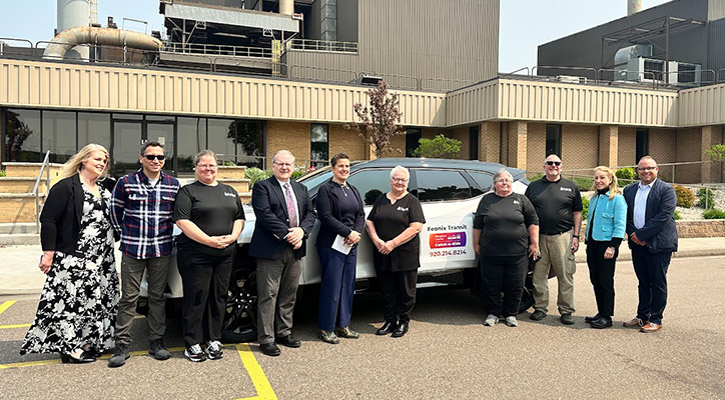
Waupaca County Catch a Ride provided over 22,000 rides in three years. At the beginning of the pilot program, there was more capacity available than employees participating, so people could access rides for reasons other than work. Once demand grew, the program focused solely on employment. Over three years, 20,000 of the 22,000 rides were work-related, with 633 unique employees participating. One employer — the biggest employer participating in the pilot program — recorded over 5,000 rides for almost 90 employees.
In addition, Waupaca County Catch a Ride also saw financial benefits for participants. According to a May 2025 presentation, 159 riders (one-third of riders) were able to gain or retain employment because of the pilot program. Based on these 159 riders, program coordinators estimated a return on investment of $6.76 in participant income for every dollar invested into the program.
The presentation also reported $1.08 million in new tax revenue and a reduction of $320,000 spent on public benefits like SNAP and Medicaid, with an overall return on investment of $1.40 in taxpayer benefits for every dollar invested.
In addition to taxpayer and employee benefits, the program reported $100,000 saved through fewer emergency room visits and mental health crises and a reduction of $80,000 spent on the justice system. Overall, the program had a return on investment of $11.72 in community benefits for every dollar invested.
And it's not just manufacturing employees who benefited from the program, although this was the largest group; 11% of all rides were for healthcare employees, with 33 healthcare facilities participating in the pilot program.
Mikorski added that the pilot program drivers also seemed to enjoy the program. They took extra time and effort to get people to work and were flexible with schedule changes.
Pina in Texas also saw the benefit of having attentive, trustworthy drivers. She remembered one client who did not leave his apartment during the pandemic. Coastal Plains Integrated Health delivered medications to him, and eventually this individual used Feonix transportation to go to the clinic.
According to a 2025 presentation at the National Rural Health Association Annual Rural Health Conference, the South Texas program has provided 2,881 rides and served 539 patients. A webinar from the same time reported that 98% of respondents in a survey of 41 Transportation Rx clients felt "extremely safe" and "extremely satisfied" with the rides and 2% felt "somewhat safe" and "somewhat satisfied," while 100% said they "definitely will recommend" the service to others.
Both Pina and Mikorski praised Feonix's expertise in helping them develop their programs. Pina said that Feonix was easy to work with and appreciated the organization's flexibility. She calls Lefler "the transportation guru because if you ever had a question, she would have an answer."
Through working with Feonix, I developed a new perspective on the needs for transportation.
"Through working with Feonix, I developed a new perspective on the needs for transportation," Pina said. When people have trouble accessing transportation, "individuals are discouraged and even hopeless and continue with the same habits," she said. "In the rural areas, it's hard to break out of habits when you don't have certain needs met, and that's a huge part of recovery."
Mikorski in Wisconsin said, "They brought all their knowledge from all different states that they've been working in…Now we're hearing how other communities are dealing with finding transportation issues. So it really helped us look at the bigger picture."
Feonix's Catch a Ride Network has facilitated over 150,000 rides in ten states.
Feonix's Programming Options
Feonix – Mobility Rising offers a variety of program options to help address transportation challenges across the nation. The Catch a Ride Network offers three service and pricing tiers to participants: a full-service tier where Feonix handles administration and operations; a Mobility Wallet that shares coordination between Feonix and the participating organization; and a direct booking tier in which the participating organization schedules the rides while Feonix provides some support and troubleshooting.
The Mobility Wallet program is what helps Transportation Rx patients in South Texas get rides for their appointments. Professionals like social workers, case managers, or care coordinators "prescribe" a number of rides that the patient can access through the program. Feonix has given over 4,000 wallets across the Mobility Wallet program.
Feonix also offers ADAPT training, which helps drivers learn more about supporting people with disabilities in transportation settings. The training was developed in Ann Arbor, Michigan, where people with disabilities shared best practices and their own experiences with transit. The ADAPT training is now online, about 75 minutes long, and available for free.
Feonix can also help rural communities establish Transportation Assistance Hubs (TAH), which address transportation challenges as a systemic issue, focusing on access to food, education, employment, and healthcare. A Feonix TAH has main elements like technology, transportation, and leadership, but rural communities can customize it to fit their needs and assets.
Forming a Mobility Leadership Circle, in partnership with Feonix, allows local residents to direct the program and the way the transportation service is deployed. Lefler recommended having someone dedicated to organizing and leading this circle, which she recognized is a challenge since many rural leaders are already taking on multiple roles.
While Feonix helps rural communities build or improve transportation programs, the community itself needs to determine how a program will best fit that specific area and population, Lefler said.
Funding Transportation Programs
Communities looking to implement transportation programs need to consider what resources and budget they have available. While a TAH is useful in addressing larger challenges, it is expensive, Lefler said, estimating a cost of about $500,000 to $1.5 million a year for full-time staff, marketing, outreach, fundraising, and community engagement. "A lot of communities right now do not have capacity to fund entire systemic interventions," she said.
The Feonix Catch a Ride Network is a more financially approachable solution, costing less than $5,000 per year. This option allows communities to focus on smaller programming or addressing a specific transportation concern or population in need, such as veterans or older adults. "Transportation barriers won't change systemically without a lot of organizations in the community joining the network," Lefler said, "but it can solve the problem for that hospital. It can solve the problem for that senior center."
Feonix - Mobility Rising works with communities to determine what kind of transportation program will work best for them, considering factors such as available community partners, population, and median household income.
After the three-year pilot program in Wisconsin ended, Waupaca County Catch a Ride expanded into providing rides for other reasons in addition to employment. Waupaca County became the program's sponsor in order to access state funds, and the Waupaca County Economic Development Corporation is working with the county to find matching funds.
With the change in funding, however, the program currently is not available 24/7. Users also need to book rides in advance, with limited same-day rides available for urgent requests. Waupaca County Catch a Ride is currently focused on rides related to employment, healthcare, and groceries. Program coordinators hope to go back to 24/7 access with more funding.
The Importance of Partnerships
Lefler from Feonix said if the city or county will pay for a transportation program, that may reduce the regulations from other funding sources. However, she said it's important to have multiple partners and funding sources in case one partner leaves the transportation program.
She worked with one county that had $16,000 in its budget for its public transportation program, but a bridge went out and the county had to cancel the transportation program in order to pay for repairs. "They had to cut the entire service for the county," Lefler said. "Nobody had matching funds that they could come up with on short notice. And so all the people that relied on that service weren't able to use the program."
Public, private, philanthropic partnerships are what create the strongest transportation ecosystems in rural communities.
"Public, private, philanthropic partnerships are what create the strongest transportation ecosystems in rural communities," she said.
In Wisconsin, finding organizations already working to address transportation issues helped the Waupaca County Economic Development Corporation "pull a network together," Mikorski said. "As we started the program, we kept everybody involved as a Mobility Leadership Circle. We had meetings regularly for the whole group to understand what's going on, what are the results, so that everybody could help if we had issues or celebrate when we hit milestones."
Coastal Plains Integrated Health in Texas partnered with a substance use counseling service and a nonprofit focused on education, health, and housing. All partners use the same platform to make Transportation Rx referrals.
"Transportation is required to access pretty much everything, so you want all of the partners who benefit from the program to be invested," Lefler said. "Are there foundations in the community? Are there businesses that would contribute? Are there hospital systems or healthcare partners that would help contribute?"
Lefler said Feonix is available to help rural communities with transportation issues or direct them to other resources. "We are really passionate about addressing mobility barriers in communities and focusing that model on community-driven change," she said.

Allee Mead is a web writer for the Rural Health Information Hub. She has written on important rural issues, including maternal mortality and farmers' mental health, and has presented nationally on RHIhub's opioid resources. Originally from rural North Dakota, she has a master's degree in English. Full Biography
View all articles by Allee Mead