

May 13, 2026
Where Primary Care and Clinical Pharmacy Services 'Intersect': Louisiana Program Helps Patients Understand and Manage Medications
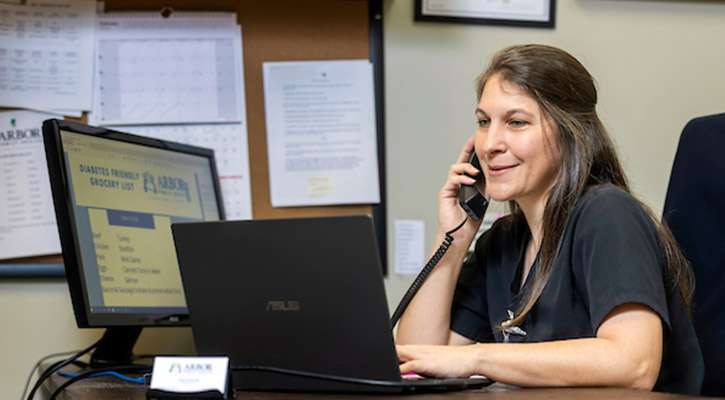
Some patients only knew their pills by color: a blue pill every day, a white one every other day. Others had trouble picking up their prescriptions on time and weren't sure what to do if they missed a dose — should they double up tomorrow, or proceed as usual? Some had questions about side effects, and others couldn't keep track of the various medications they'd been prescribed between their primary care and specialty providers, leading some to fall through the cracks.
These are the problems Arbor Family Health, a Federally Qualified Health Center (FQHC) in rural Louisiana, is tackling with an innovative new program that connects chronic disease patients with nurse health coaches and clinical pharmacists. The new program, Intersect: Individualized Collaborative Drug Therapy Program, takes a team approach to making sure patients are educated on, and able to manage, their medical prescriptions and care.
"We've got to create more knowledgeable patients to strengthen their ownership of their disease," said Linda Matessino, Director of Grant Programs for Arbor Family Health.
Broadening horizons
The Intersect program is the latest iteration in nearly a decade of similar, evolving programs at Arbor Family Health. The organization, which has clinic locations in Pointe Coupee Parish and Iberville Parish, started with a program in which nurses, trained as health coaches, helped chronic disease patients to track and manage their care. That meant attending appointments, making sure follow-ups were scheduled, and conducting regular check-ins with patients to help them stay on track.
We're the bridge that's going to bolster you up. And then when you kind of fall back down, bolster you up again.
"It is a lifelong journey to live with [chronic disease]," Matessino said. "You have your ups and downs, and you're tired of it. We're the bridge that's going to bolster you up. And then when you kind of fall back down, bolster you up again.
"The role of the health coaches is to improve your knowledge regarding the treatment of your chronic disease and improve your medication literacy and adherence," Matessino continued. "And let us help make that easier for you as you try to remember all this."
As the program went on, the health coaches began to recognize a pattern: that many patients didn't know as much about their own medications as they should.
Arbor Family Health "learned a lot" through that initial program, Matessino said. "And then we broadened our horizons by recognizing that there's a discipline that's not here at the table with us." When the grant funding ended for that program and the time came to apply for new funding, "In the design of this second go-around we said, 'We've got to have that player — pharmacy — there with us.'"
If patients could talk with a clinical pharmacist for a comprehensive medication review (CMR), Matessino thought, they could have their questions answered and their medication adherence improved with this expertise. But finding and affording a clinical pharmacist in a rural setting proved challenging. Instead, Matessino reached out to Xavier University of Louisiana's College of Pharmacy in New Orleans to explore a partnership that would use the university's Telehealth Center.
Four years later, the program serves more than 250 patients at two Arbor clinic locations. Health coaches check in with patients monthly, and clinical pharmacists at Xavier — a mix of faculty and supervised students — conduct annual CMRs with patients over the phone. The health coaches collaborate frequently with the clinical pharmacists on the patients' medication regimens.
In these annual reviews, the pharmacists answer any questions the patient might have and ask the patient questions to make sure they are able to access their prescriptions and that they're taking them correctly and safely. The pharmacists also check that all of the patient's medications are included in their electronic medical record (EMR) and that no prescriptions from specialty providers have gotten lost in the shuffle. If the pharmacists believe a different medication may serve the patient better, they can make a recommendation to the patient's primary care provider within their scope of practice.
That relationship… gives patients a sense that they have a safety net and that someone is working together to help them.
"It's been really great," said Iman Borghol, a clinical pharmacist and director of the Xavier University Telehealth Center, who works with Arbor patients. "They know exactly who we are [when we call] and they know that we are there for them. That relationship, the confidence that has been built between us and the health coaches, gives patients a sense that they have a safety net and that someone is working together to help them."
Building trust
That trust — and that willingness to answer the phone when the Xavier pharmacists called — doesn't come automatically.
Tanya David has worked as a nurse health coach at Arbor for six years, since the initial program without pharmacy services. Over that time, she's built strong relationships with her Intersect clients.
David, who is one of two coaches in the program, oversees 250 Intersect patients. In a typical day, she'll sit in on her patients' appointments at Arbor's New Roads clinic, taking some time first to privately chat with the patient about their health, lifestyle, and to encourage them to participate in a CMR with a clinical pharmacist if they're due for one. She'll listen to the provider's plan of care and follow up with the patient a few days later to make sure they've scheduled a follow-up appointment or picked up any prescriptions they need.
She typically checks in with each patient once a month — or every two weeks, if they're new to the program — and will conduct these check-ins over the phone if the patient doesn't have a clinic appointment scheduled that month.
Building a relationship with new patients can be challenging at times, David said, especially if a patient frequently changes phone numbers, is difficult to get ahold of, or misses appointments.
"When you have noncompliant people, it's hard to get them to keep coming back until they trust you and say, 'Hey, yeah, this is going to work. This is what I need to do. I need to take care of myself,'" David said.
When talking to patients, it's helpful to "get on their level," rather than taking on an authoritative tone, David advised — one size doesn't always fit all.
"Figure out what's going on in their life," she said. "The medical side is important, but learn about their lives too. You may see those things that they need that come up and you can help them out. The more you speak to them, the more they trust you and then they start turning to you."
These established relationships, carried over from program to program, turned out to be crucial to the success of the Intersect program, she and the pharmacists say, especially for patients who might have been hesitant to speak to the pharmacists otherwise.
"Whenever you build that relationship with patients, they're more likely to say, 'Okay, yes, I will speak to this person,'" David explained. "And some of our newer patients might be a little more hesitant — they're still figuring me out, I'm still figuring them out — but they trust us enough that they agree to it."
Answering the call
For patients who have never experienced medication therapy management (MTM) or a CMR, the prospect of a wide-ranging conversation with a pharmacist can be daunting, David said. That's where communication comes in.
"I do have a lot of patients where you have to explain to them why it's important and then they're like, 'Okay, yeah, I get it,'" David said. "And then once they do have it, they're like, 'Wow, [the pharmacists] are wonderful,' and they love them."
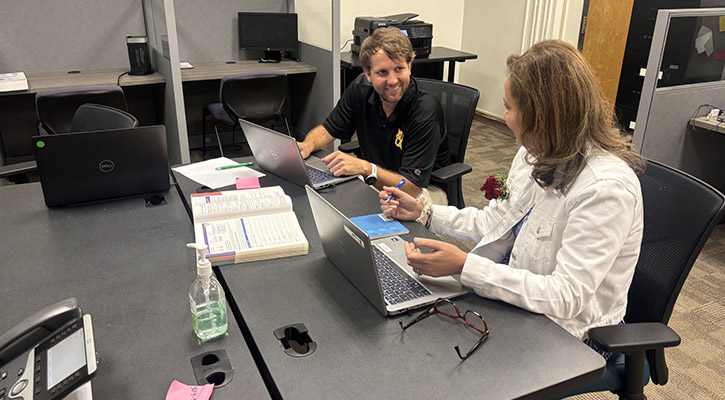
Once patients had agreed to the program, the next hurdle came: getting them to pick up the pharmacists' calls.
"Patients need to have the proper expectation and know that [a call is] coming in order to answer in a telehealth setting," said Thomas Maestri, a clinical pharmacist at Xavier who is involved in the program. "We all get these potential spam calls or calls from unwanted numbers. And so if you see [an unknown number], then you might say, 'Oh, I just won't answer.'"
Again, the program's two health coaches played a key role in conveying these expectations to patients, Maestri said: "The relationship that the health coaches have built with the patients really allow for great communication to occur."
Being cognizant of patients' schedules and availability — who might not be able to pick up during the work day, for instance — is also important, the pharmacists noted. In these situations, flexibility is needed.
"If we work eight to five and patients are only available after five o'clock, I don't mind calling them after hours," Borghol said. "It's best not to call them when they are at work."
At the same time, the pharmacists and health coaches have been intentional about building relationships with each other: the two teams meet monthly and have visited each other in-person at the clinics and at Xavier's New Orleans campus, which are several hours apart.
A learning experience
Borghol, who specializes in internal medicine and ambulatory care, and Maestri, who specializes in mental and behavioral health medications, are two of the Xavier faculty members involved in the Intersect program. The program has been a valuable learning experience for their students and residents, they say. Fourth-year pharmacy students participate in the program during their rotations, making calls to Intersect patients under faculty supervision.
"They're used to seeing [patients] face-to-face," Borghol said. "So for them, that's the first shock. They tell me how hard it is to learn how to speak to patients over the phone and get across to them and connect with them. That's really a learning curve for them."
While the experience of performing CMRs helps the students from a medical training perspective, Maestri said, the "rapport building" aspect of the program is what he sees as most valuable as a teacher.
When you're not sure who's on the other end of the phone, you have to take time to get to know them and understand them. I think the empathy that is built from that is very important.
"You really have to take some time to do that on the phone, whereas it's a little bit easier to relate and get on the same page when you're looking at someone face-to-face," Maestri said. "When you're not sure who's on the other end of the phone, you have to take time to get to know them and understand them. I think the empathy that is built from that is very important."
For some students at the New Orleans-based university, the Intersect program may be their first hands-on experience with rural patients, Borghol and Maestri noted.
"We're here in New Orleans where we're in the city, and that's what we see," Maestri said. "And now [the students] are getting to hear about some of [the Intersect patients'] very real experiences that can impact them taking their medications, which are things that we wouldn't maybe always think about."
"They start talking to the patients and they tell me, 'Oh my God, they have to go 40 minutes to a hospital,'" Borghol added. "They realize that what we do for them is very important. It's really good to teach the students that not everybody has easy access to healthcare, and what we can do to fill the gap."
A journey of learning
Now in the fourth year of a five-year grant, Matessino says the past several years of the program have been an exercise in "continuous quality improvement."
"You review, you revise, you go back and do it," Matessino said. "And 'Okay, is that working? Or do we have to tweak it a little bit more?'"
When the current grant ends, Matessino expects there will be "a lot more tweaking" in Arbor's next iteration. But she hopes other rural clinics that can't afford to have a clinical pharmacist on staff can learn from the work they've done within Intersect.
"It's a journey of learning," she said. "And I just thank our lucky stars that we've come this far."
A few questions Intersect pharmacists ask:
- Where do you store your medications?
- Do you remember to take them?
- What do you do when you skip a dose?
- Do you know what this particular medication is supposed to do?
- What pharmacy do you use?
- Do you have any difficulty getting to the pharmacy or picking up your prescriptions on time?
Gretel Kauffman has been a web writer for the Rural Health Information Hub since 2022. She writes on a variety of rural-specific issues in the Rural Monitor and Models and Innovations. Gretel has a bachelor of arts degree in American Studies from the University of Notre Dame. Full Biography
View all articles by Gretel Kauffman