

Oct 28, 2026
Rural Skin Cancer Patients Tend to 'Slip Through the Cracks.' These Programs Are Trying to Change That
Kyle Rudningen, a dermatologist in Minnesota, has worked with both rural and urban populations. He spent three years treating largely rural patients in the regional hub of St. Cloud, and now practices in Plymouth, a suburb ten miles from downtown Minneapolis.
In suburban Plymouth, he typically sees patients with "small cancers," he said — "often pencil eraser size" — which tend to be "very easy" to address. With many of these patients living a quick 5- or 10-minute drive away, "it's minimal burden for them to follow up."
That's in sharp contrast to his experience practicing in St. Cloud, a city of 68,000 that serves as a medical hub for the surrounding rural areas. Patients often came from up to two hours away, according to Rudningen, and had "very, very large cancers that were ten times that size" — cancers that were "much more difficult to get out." Follow-up was "much more difficult," too: "If I wanted them to come back at all, it was four hours in the car just to see me."
Many of these rural patients had "slipped through the cracks," Rudningen explained. "It was so difficult for them [to see a dermatologist] that they just didn't come."
It was so difficult for them [to see a dermatologist] that they just didn't come.
Skin cancer is the most common form of cancer in the U.S., according to the Centers for Disease Control and Prevention (CDC), with an estimated one in five people developing some form of it by age 70. Farmers, ranchers, outdoor recreational guides, and others who spend their days in the sun are especially at risk.
But for many rural residents, routine checks for skin cancer are anything but routine. Geographic distance, a scarcity of specialty providers, and other financial and logistical challenges can prevent rural patients from receiving dermatological diagnoses and care in a timely manner. And while the density of rural dermatologists has increased overall, the gap in dermatologists per capita between rural and urban areas has widened. The density of dermatologists in metro areas is five times greater than the density in nonmetro areas, according to 2023 data from the Health Resources and Services Administration (HRSA).
In response, programs across the country are taking a range of approaches to make dermatology care more accessible to rural residents: bringing mobile dermatology care to rural communities, equipping rural primary care providers with the tools and knowledge they need to identify and treat dermatological issues themselves, and establishing a rural dermatology residency in the hope that up-and-coming dermatologists will stay in the kind of rural setting where they trained.
'Life-Changing' Mobile Care
Amy Snow, a dermatology physician associate, was first struck by the lack of dermatological care in rural Oregon when she relocated her nonprofit, Project Happy Face, from Southern California to the small city of Bend. In its original iteration, Project Happy Face focused on providing free acne treatment to disadvantaged teenagers — but after relocating to Bend, Snow realized that, without accessible public transportation, it would be difficult for teens in the surrounding rural communities of Central Oregon to come to her office for treatment. She started looking into building a mobile unit that could travel to the teens instead.
"When I looked at the map further, I started to realize, 'Oh, there's no dermatology care east of Bend,'" Snow recalled. "So I thought, 'If we get a mobile unit, we can expand and provide full dermatology services to all of these rural areas. Because if we're already traveling to these rural destinations and treating teenagers with acne, there are probably tons of community members that could also really use some dermatology care.'"
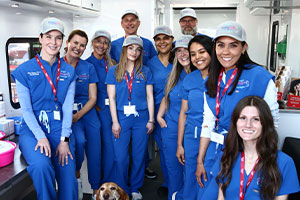
Today, Project Happy Face's mobile unit travels around providing free skin cancer screenings and other types of dermatological care to patients in Oregon, Idaho, Illinois, Utah, and California. Many of the patients Snow and her team see are a four- to six-hour drive from the nearest dermatologist's office, a distance that is often prohibitive for people who can't afford the gas or time off for the drive.
"These communities are heavy in ranching and farming, and they just don't have the time to take a day and come to an urban healthcare system for a dermatology appointment," Snow said.
These communities are heavy in ranching and farming, and they just don't have the time to take a day and come to an urban healthcare system for a dermatology appointment.
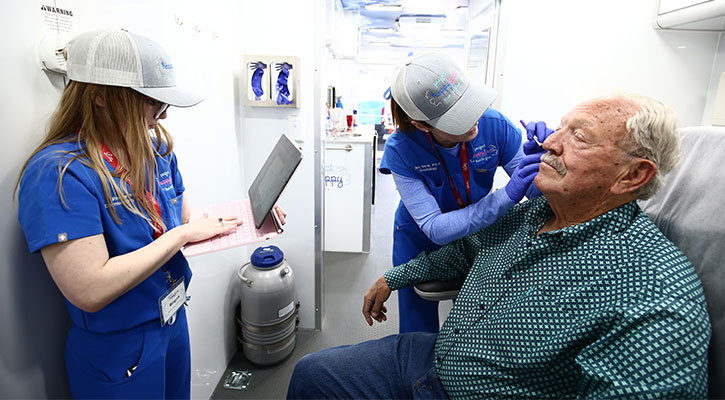
Patients are checked head to toe for concerning lesions, and a biopsy is performed if needed. Results typically come back within a week, and Project Happy Face then refers the patient to a local provider or health system for treatment if needed. Oftentimes, if Project Happy Face's route circles back to the same area, patients will return to the mobile unit for treatment.
In addition to performing free skin cancer screenings, the mobile unit is equipped to freeze precancerous lesions, warts, and skin tags with liquid nitrogen, remove cysts, perform chemical peels and extractions, and perform biopsies. All services are free, thanks to various sponsorships and a partnership with a local dermatopathology office.
"Even just removing a wart or an inflamed seborrheic keratosis can be life-changing," Snow said, "as most rural clinics lack liquid nitrogen, an essential tool for basic dermatology conditions."
Over the years, Project Happy Face has built partnerships with rural clinics, first responders, school districts, and community leaders who help to facilitate the mobile clinic's visits and spread the word that dermatological care is coming. Patients can book an appointment in advance, and often return for an annual screening each year; the mobile clinic tries to return to communities at least once a year when possible.
"It's been completely rewarding to build that rapport with the rural communities," Snow said. "They know I am available for a telehealth appointment in between visits. And they know that we're coming back for them, and we're not just a one-stop show."
Homegrown Dermatology Care
Adam Byrd always knew he wanted to practice in his hometown of Louisville, Mississippi. So after completing his medical training in Minnesota, he called the University of Mississippi (UM) School of Medicine to ask whether the university would be interested in opening a rural satellite dermatology clinic in Louisville, a town of 6,000 that lies 100 miles northeast of Jackson.
Ten years later, Byrd runs a full-time academic clinic in Louisville staffed by university employees, residents, and students. The clinic is host to UM's Rural Dermatology Residency Track, the only program of its kind in the country. The track accepts one resident per class — a "rural-minded person, ideally from a rural background," who wants to practice in a rural area, Byrd said — who spends three consecutive months each year training one-on-one with Byrd at the Louisville clinic.
Northern Mississippi, where Louisville is located, is largely rural but not lacking in dermatologists, Byrd noted — something he attributes in part to UM's dermatology residency program, which has produced between three and six new dermatologists per year for the past decade. Whether people can afford dermatological care, however, is a different story: Unlike the UM satellite clinic in Louisville, most dermatology practices in the region don't accept Medicaid, Byrd said. As a result, Byrd and his residents see patients from all across the northern part of the state.
"I tell my residents all the time that rural dermatology is not a specialty — it's the same dermatology that you would see in Miami or Cincinnati or St. Louis," Byrd said. "But the rural approach is different."
…Rural dermatology is not a specialty…but the rural approach is different.
Byrd likens rural dermatology to working as a family doctor: "In a rural area, you have to be willing to see everyone from small infants to nursing home patients, and you deal with everything from complex medical stuff and skin cancers to college kids with acne and cosmetics," he said. "Whereas in a more urban area, you can kind of focus on one area and only do that."
Subspecialists are often an inconveniently far distance away, he added, "so the rural dermatologist has to be a well-trained, broad-based physician that can handle a wide variety of skin diseases."
Byrd spends nine months of the year working one-on-one with the rural track residents from each residency class, but they aren't the only residents who have the opportunity to gain rural experience. Typically, one of the traditional, non-rural track residents will come up for a rotation for the remaining three months of the year, he said.
"A lot of the traditional derm residents like to come up to Louisville and work with us because we do more procedures here," Byrd said.
More than 100 medical students, hailing from 30 different states, have also completed rotations at the Louisville clinic, where they have the chance to help with biopsies, freeze skin lesions, and numb patients for procedures, according to Byrd. For students to be considered for the rural residency track, they must have completed a full two-week rotation in Louisville; these rotations are open to applicants from any medical school. An applicant's willingness to follow through with a rotation, and their rural roots, are two of the most important criteria when selecting rural track residents, Byrd said.
"When we look at recruiting, we're always looking for people that are from a rural area," Byrd said. "They don't have to be from the state of Mississippi, but we're looking for people who are more likely to go back to a rural area — ideally their hometown — and work with a rural population."
Supporting Rural Providers
Hands-on training is also at the core of an effort to improve dermatological care in rural Wisconsin — but for a different kind of trainee.
In Wisconsin, like Oregon, dermatology care is largely concentrated in urban areas. A 2020 study by University of Wisconsin researchers found that the state's most rural regions had the worst ratios of population to dermatologists.
"There's a maldistribution of dermatology specialists across the state of Wisconsin, with rural areas being grossly underserved," said Daniel Bennett, a professor of dermatology at the University of Wisconsin–Madison (UW).
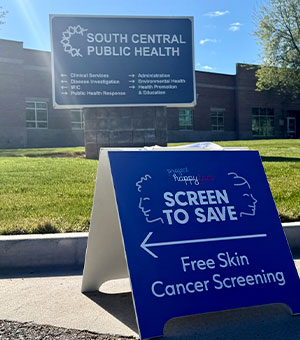
Bennett is principal investigator for the new Specialty Training at Rural Sites – Dermatology (STARS-D) program, an offshoot of the broader STARS program from the Orion Initiative at the UW School of Medicine and Public Health. The STARS model trains rural primary care providers in subspecialty fields, equipping them with the hands-on skills to provide basic care when seeing a specialist is inconvenient or impossible.
"We were hearing from our rural colleagues that they were struggling to get patients referred to dermatologists without [the patients] having to travel long distances," Bennett said. "These primary care physicians are seeing a lot of patients with skin concerns, but they don't have easy and rapid access to dermatologists. And these rural clinicians would like to be supported in their ability to provide care for common skin conditions."
All of the programs under the STARS umbrella, including the STARS-D program, are "really focused and designed to make human connections," said Amy Kind, chief executive officer of the Orion Initiative. The Orion Initiative is philanthropically funded and aims to build partnerships between the academic community at the UW School of Medicine and Public Health and rural communities across the state.
"We have heard from rural physicians that they have many opportunities to sit alone in a room in front of a screen and watch a recorded video or take some kind of online course," Kind said. "But what they really needed was someone to talk to about the patients they're actually seeing, and to build that relationship in a way that was authentic."
For STARS-D's pilot year, which wraps up in November, the program has partnered with two rural Critical Access Hospitals in southwest Wisconsin. The program was designed in collaboration with these rural partners and includes three components: preceptorships, shadowing UW dermatologists, and a final retreat with hands-on skill sessions.
The preceptorship component began with onsite visits: UW dermatology faculty traveled to the rural clinics monthly for a day of seeing patients with skin concerns alongside the primary care physicians. These visits also included a "lunch and learn" session with a planned lecture on a dermatological topic. After several months, these in-person visits transitioned into virtual visits, in which the primary care physicians use iPads to consult with UW faculty while seeing patients.
Meanwhile, three of the physicians in the pilot program have visited Madison at least once. There, they've been exposed to a range of procedures and received hands-on training while shadowing UW-affiliated dermatologists. At the end of the pilot year, all of the providers will gather in Madison again for a day-long retreat that will include hands-on skill sessions with a simulated skin model, lectures, and case-based work.
The care of common skin conditions is well within the scope of practice for a primary care physician.
"The care of common skin conditions is well within the scope of practice for a primary care physician," Bennett said. "And our goal is to simply work with them to help build their confidence in their ability to provide care that is well within their scope."
Gretel Kauffman has been a web writer for the Rural Health Information Hub since 2022. She writes on a variety of rural-specific issues in the Rural Monitor and Models and Innovations. Gretel has a bachelor of arts degree in American Studies from the University of Notre Dame. Full Biography
View all articles by Gretel Kauffman