

Oct 14, 2026
Philanthropic Funding Helps Rural Providers Access Ultrasound Equipment and Training
by Allee Mead
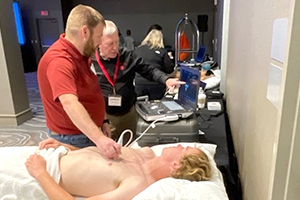
When a patient presents at a rural emergency department with an urgent concern, a quick diagnosis and informed clinical decision-making can make all the difference in whether that patient lives and maintains quality of life. Too often, needing to wait for a specialist or diagnostic testing like an echocardiogram can cost precious minutes. Thanks to a new philanthropic initiative, rural healthcare facilities in four states now have access to a real-time diagnostic evaluation tool called point-of-care ultrasound, or POCUS.
The Leona M. and Harry B. Helmsley Charitable Trust provided funding so rural healthcare facilities could access equipment and training to make diagnoses more quickly. Through its Rural Healthcare portfolio, the trust granted over $70 million in Minnesota, Nevada, North Dakota, and Wyoming for over 600 ultrasound devices as well as training and tuition assistance.
Some of these new devices are POCUS machines, used by members of the healthcare team already at the patient's bedside for immediate assessment. This technology helps providers determine next steps of care in both hospital and clinic settings.
It's one of the very few innovations in medicine that brings the provider back to the bedside.
While CT scans and X-rays provide valuable information, Tom Pahl said, they can be difficult to use on patients who are unstable. Pahl is an emergency medicine physician assistant at Glacial Ridge Health System in rural Glenwood, Minnesota. Providers can use POCUS systems to examine hearts, lungs, and other body parts without moving the patient. "It's one of the very few innovations in medicine that brings the provider back to the bedside," he said.
Pahl is also a co-clinical director of High Quality Medical Education (HQMEDED), a nonprofit academy founded by emergency medicine physicians and based in Minneapolis, Minnesota. HQMEDED is training health professionals in Minnesota, North Dakota, and Wyoming whose facilities received Helmsley funding.

Pahl said POCUS first began in the urban Hennepin County Medical Center in the 1980s. Dr. Dave Plummer, who later helped found HQMEDED, was seeing an increase in stabbing and shooting victims, who often died before providers could determine the best course of treatment.
Specifically, Plummer wanted a way to more quickly determine if a patient had cardiac tamponade (pressure on the heart from too much blood or other fluid). This led to using ultrasound at the bedside to examine the heart.
Pahl said this same urban hospital now has 40 POCUS devices. "If they're using it in their resuscitation room to make these decisions rapidly, how much more value does it have one or two hours before that at a rural place?" he said.
Helmsley Charitable Trust's ultrasound initiative:
- Healthcare facilities in Nevada in 2022 received $4.2 million for over 50 ultrasound devices, training, and tuition assistance.
- Healthcare facilities in Minnesota in 2023 received almost $18.3 million for nearly 200 ultrasound devices and $8.1 million for training.
- Healthcare facilities in Wyoming in 2024 received almost $13.9 million for 143 ultrasound devices and training.
- Healthcare facilities in North Dakota in 2025 received $27.4 million for over 215 ultrasound devices and training.
Benefits of POCUS in rural health

When rural patients have to be transferred from a rural emergency department to a larger facility, "it delays care, it delays diagnosis of a medical condition," Walter Panzirer said. Panzirer is a trustee with the Helmsley Charitable Trust and Leona Helmsley's grandson. POCUS helps rural providers determine whether a patient needs to be transferred to a larger facility or can receive treatment locally.
Even though rural facilities might already have ultrasound capabilities, there is still a benefit from POCUS, Dr. Waco Goodnight said. Goodnight is a pediatrician at McKenzie Health in rural Watford City, North Dakota. "In a rural hospital, the on-call sonographer may be 15 minutes away. We don't have 15 minutes to wait," he said. "Getting that focused information at the bedside, without delaying CPR, can change what we do immediately."
Goodnight said POCUS, alongside his clinical assessment, helped guide whether a child needed antibiotics for pneumonia or treatment for asthma. In another patient, it helped identify hydronephrosis associated with a blocked ureter. That patient required a procedure to relieve the obstruction rather than antibiotics for a urinary tract infection.
When providers use POCUS, they can also save their patients from having to make multiple appointments as providers try to diagnose, Lynn Welker-Fevold said. She is chief of innovation and strategy and president of the Benefit Fund at McKenzie Health.

In 2025, McKenzie Health received $803,545 from Helmsley to buy nine ultrasound devices. McKenzie Health serves Watford City, North Dakota, and the larger McKenzie County area and has outreach clinics in three North Dakota communities and one Montana town. "They really have done a lot to help us in western North Dakota," Welker-Fevold said.
The funding is meant to have a ripple effect: As more providers gain competency in ultrasound, they can train others. Helmsley grantees were able to receive training from organizations like HQMEDED and from local colleges and universities, but those institutions may have a limited supply of preceptors.
"Generally speaking, there's a lack of mentors and preceptors for doing ultrasound," Wayne Booze said. He is the Rural Healthcare program director at Helmsley Charitable Trust. "By providing training throughout the states, it gives more opportunities for those education programs…to expand their footprint and the crop of providers that might be able to help be a preceptor."
Other training opportunities: University of Idaho POCUS curriculum
The University of Idaho School of Health and Medical Professions in rural Moscow created a POCUS curriculum for first-year medical students. It began as a 16-week elective course but is now integrated into the formal curriculum. The university has also incorporated ultrasound training into its graduate athletic training and Doctor of Anatomical Science programs.
Josh Johnson, Clinical Assistant Professor, has received positive feedback from medical students who have successfully used POCUS on supervised clinical rotations in rural settings. One student drained fluid from a patient's swollen knee under ultrasound guidance. POCUS facilitated immediate relief for the patient, while the care team worked toward a definitive diagnosis and treatment plan with the patient.
Bringing the equipment and training to rural
Challenges to accessing POCUS include funding, travel, and time to become competent with new technology.
Funding equipment is a huge barrier for rural facilities, Pahl said. When his Critical Access Hospital received its first ultrasound machine, budget constraints meant it had to rely on outside help beyond its normal budget. Without external funding, hospital auxiliaries and outside philanthropic groups must get involved. "It takes the whole community," Pahl said. "Auxiliaries will do just about anything to raise money, from raffles and bake sales to galas and balls. That is what makes Helmsley's substantial investment so generous and so important."
It's a great tool, but if you really can't utilize it well, it just doesn't have value.
In some cases, hospitals already have the equipment, but providers haven't mastered the skills yet. Pahl recalled traveling to different hospitals in Minnesota and seeing "a lot of dusty ultrasound machines that no one really knew how to use…It's a great tool, but if you really can't utilize it well, it just doesn't have value," he said.
"It's not that sick people don't show up at rural places," Pahl said. "It's just that they don't show up as frequently, so you don't get all of the repetition."
And if providers have to leave their facilities to attend training, rural healthcare facilities may have to temporarily close or hire locum tenens. "We recognize travel as a barrier," Panzirer said. By bringing the training to rural communities, Helmsley saves facilities money.
Rural hospitals' POCUS journey
Goodnight recalled screening an infant for critical congenital heart defects (CCHD). The baby failed the screening and needed an echocardiogram, but McKenzie Health wasn't able to provide one at that time. The baby was transferred by an air ambulance to a larger facility for an echocardiogram.
Goodnight asked administrators about ultrasound training so providers could look at the heart and determine if a child needs to be transferred in an air ambulance or can wait for an echocardiogram. Welker-Fevold told him about the Helmsley grant, from which Goodnight received an ultrasound probe and completed eight hours of in-person training and about 20 to 25 cardiac ultrasound scans.
About a year later, Goodnight evaluated two other infants who failed CCHD screening. Bedside ultrasound, the clinical workup, and consultation with a pediatric cardiologist helped guide their care. One infant did not need emergency transfer and later received a non-emergent echocardiogram, with reassuring results. The other infant passed repeat screening 12 hours later, without needing air transport or a formal echocardiogram.
In Minnesota, the Glacial Ridge Health System CEO asked Pahl to apply for the Helmsley funding. On the application form, Pahl explained that some hospitals already have ultrasound equipment but aren't trained in using it. He offered to train these facilities in POCUS.
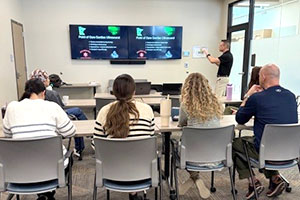
Three months later, he met with Helmsley staff to discuss designing a training program that traveled to rural facilities and hosted regional conferences. Pahl said working with Helmsley's Rural Healthcare team allowed HQMEDED to build a longitudinal curriculum unlike anything the organization had done before.
HQMEDED had taught one-day courses for more than 20 years, Pahl said, but they had limited lasting impact. "The same providers would come back two or three years later, and they hadn't really advanced their skills," he said.
As opposed to a one-day workshop, the longitudinal training provides practice, feedback, and repetition, Pahl said. In addition, participants build relationships and exchange ideas.
Training involves yearly visits to participating facilities for onsite education as well as regional conferences, textbooks, and recorded online lectures. HQMEDED also provides a helpline, available Monday through Friday, to offer expert guidance with capturing or reviewing images and other questions.
Physicians, physician assistants, nurse practitioners, certified registered nurse anesthetists, and certified nurse midwives are eligible to participate in the Helmsley-funded program. During site and community visits, HQMEDED opens the training to paramedics, registered nurses, respiratory therapists, and anyone else in the facility whose patient care could improve with POCUS, Pahl said. HQMEDED has trained over 1,000 providers so far through the Helmsley grant.
In addition, HQMEDED works with each facility to develop a local champion and shares its expertise in how to build a POCUS program, including credentialing standards and policies. HQMEDED instructors act as mentors, and HQMEDED developed a toolkit.
Other training opportunities: PRIME POCUS Scholars Program
The PRIME POCUS Scholars Program is a new program offered through a partnership of various academic institutions led by the University of North Carolina School of Medicine. The nine-month program will provide in-person two-day workshops, monthly online sessions, small-group mentorship, and a formal standardized assessment. Participants will also complete readings and homework and will scan and upload images for review.
The program will offer two cohorts a year: one through the University of North Carolina starting every January and one through the University of Colorado Anschutz starting every August, with cohorts beginning in 2027. Ryan Paulus, executive director of PRIME POCUS Learning Network, hopes to expand the program and have a learning hub in every state. Scholarships for rural providers are available through the Rural Residency Planning and Development Technical Assistance Center.
Outside of this program, PRIME POCUS Learning Network offers hands-on workshops at its regional and satellite hubs and program support for residency programs and outpatient clinics. In addition, the network is creating an online cognitive curriculum that will target the cognitive components of POCUS with image interpretation and clinical reasoning.
Time, money, and lives saved
In North Dakota, Goodnight described caring for a newborn with low Apgar scores following delivery with the umbilical cord wrapped around the neck. After the baby was stabilized, the clinical evaluation indicated that the infant needed cooling treatment at a tertiary center. Goodnight used POCUS to assess the heart and lungs and look through the fontanelle for gross abnormalities. He saw no obvious concerning findings on those limited scans and shared the findings with the NICU transport team to help focus the handoff and ongoing evaluation.
"By the time the NICU team arrived, we could share our bedside findings alongside the rest of the workup and give them a more focused picture of the baby's condition," Goodnight said.
In one child without fever and with only minimal tenderness, swelling initially appeared to be a reactive lymph node. POCUS suggested an abscess, prompting further evaluation rather than watchful waiting or antibiotics alone at home. The child was subsequently hospitalized and underwent incision and drainage.
Goodnight said POCUS can help avoid unnecessary testing or travel when appropriate and direct resources toward the care the patient needs. He described a child with a small lymph node that appeared reactive and benign on examination. The parents were anxious because of a family history of leukemia and lymphoma. The ultrasound findings provided additional reassurance, and the parents did not request blood work or other testing that Goodnight considered clinically unnecessary.
Pahl praised Goodnight's work as a POCUS champion, saying, "We need those local people who are really passionate about it."
Panzirer at Helmsley recommended having "an oversupply of staff" trained in the use of POCUS. That way, no matter who's scheduled to work, someone can use the equipment on a patient. Pahl said everyone in Glacial Ridge Health System's emergency department is credentialed for all the ultrasound applications.
"I equate it to a stethoscope. All doctors have stethoscopes," Panzirer said. "All doctors should have training and have access to point-of-care ultrasound because it's a diagnostic tool that's minimally invasive on the patient."

Allee Mead is a web writer for the Rural Health Information Hub. She has written on important rural issues, including maternal mortality and farmers' mental health, and has presented nationally on RHIhub's opioid resources. Originally from rural North Dakota, she has a master's degree in English. Full Biography
View all articles by Allee Mead